
Hiring a Contractor Checklist: 15 Essential Steps Before You Hire

Hiring the wrong contractor can cost your business far more than the contract itself. Missed deadlines, poor workmanship, compliance issues, unexpected expenses, and safety risks can quickly turn a simple project into a costly problem. That’s why having a hiring a contractor checklist is essential before signing any agreement.
Whether you’re a company owner, HR manager, procurement specialist, or operations leader, this guide will help you evaluate contractors with confidence. You’ll learn how to verify qualifications, reduce hiring risks, compare options fairly, and make informed decisions using a practical, step-by-step framework that saves time, protects your budget, and improves project outcomes.
What Is a Contractor?
A contractor is an independent professional or business hired to complete a specific task, project, or service for an agreed period rather than becoming a permanent employee. Contractors are commonly used when organizations need specialised expertise, additional workforce capacity, or temporary support without making a long-term hiring commitment.
Unlike employees, contractors generally manage their own schedules, provide their own equipment when applicable, and operate under a service agreement that defines project expectations, deliverables, and payment terms.
As businesses continue to adopt flexible workforce strategies, contractors have become an essential part of modern operations across industries, including construction, manufacturing, healthcare, engineering, information technology, and logistics.
Understanding what a contractor does, and how contractors differ from employees, is the first step toward making a smart hiring decision.
Definition of an Independent Contractor
An independent contractor is an individual or company that performs work under a contract rather than through traditional employment. Contractors are usually responsible for:
- Managing how the work is completed
- Paying their own taxes (depending on local laws)
- Providing specialized skills
- Working with multiple clients
- Delivering agreed project outcomes
Government agencies such as the U.S. Internal Revenue Service (IRS) emphasise that the level of control over how work is performed is one of the key factors distinguishing contractors from employees. Businesses should classify workers correctly to avoid tax and legal issues.
Expert Tip: Before hiring, always confirm whether the role legally qualifies as contractor work under your country’s employment regulations.
Contractor vs Employee
Many businesses mistakenly treat contractors like employees, creating unnecessary compliance risks.
|
Contractor |
Employee |
|
Hired for specific projects |
Permanent or ongoing role |
|
Controls how work is completed |
Employer directs daily work |
|
Usually provides their own tools |
Employer provides equipment |
|
Paid per project or contract |
Paid salary or hourly wage |
|
Limited company benefits |
Receives employee benefits |
| Temporary engagement |
Long-term employment |
Choosing between a contractor and an employee depends on your business goals, project duration, budget, and operational requirements.
Common Types of Contractors
Contractors work across nearly every industry. Each type brings unique expertise to help businesses complete specialised work efficiently.
Construction Contractors
Construction contractors manage residential, commercial, and industrial building projects. Their responsibilities often include:
- Site management
- Structural work
- Renovations
- Electrical coordination
- Plumbing coordination
- Safety compliance
They frequently coordinate subcontractors and ensure projects meet local building codes and regulations.
Manufacturing Contractors
Manufacturing contractors help businesses increase production capacity during periods of high demand.
They may provide:
- Machine operators
- Assembly workers
- Production technicians
- Warehouse support
- Maintenance specialists
Manufacturers often rely on contractors to scale operations quickly without expanding permanent payroll.
Skilled Trade Contractors
Skilled trades require technical expertise developed through apprenticeships, certifications, or years of experience.
Examples include:
- Electricians
- Welders
- Carpenters
- HVAC technicians
- Plumbers
- Pipefitters
- Industrial mechanics
Hiring qualified trade contractors helps ensure projects meet safety standards and industry regulations.
IT Contractors
Technology projects often require specialised professionals for short-term assignments.
Common IT contractors include:
- Software developers
- Cybersecurity specialists
- Cloud engineers
- Data analysts
- Network engineers
- AI consultants
- DevOps engineers
Businesses frequently hire IT contractors to implement new systems or provide expertise that isn’t available internally.
Healthcare Contractors
Healthcare organisations use contractors to address staffing shortages, seasonal demand, and specialised patient care needs.
Examples include:
- Registered nurses
- Licensed practical nurses
- Medical assistants
- Physical therapists
- Occupational therapists
- Medical coders
- Laboratory professionals
Healthcare contractors help hospitals, clinics, and long-term care facilities maintain quality patient care during workforce shortages.
Engineering Contractors
Engineering contractors support infrastructure, manufacturing, energy, aerospace, and technology projects.
Typical specialities include:
- Civil engineering
- Mechanical engineering
- Electrical engineering
- Industrial engineering
- Process engineering
- Project engineering
Organisations often hire engineering contractors for complex projects requiring advanced technical expertise.
When Should a Business Hire a Contractor?
Hiring a contractor isn’t always the right solution, but in many situations, it can save time, reduce costs, and provide expertise that permanent employees may not have.
The key is understanding when temporary talent offers greater value than making a full-time hire.
Project-Based Work
One of the most common reasons businesses hire contractors is for projects with a clear beginning and end.
Examples include:
- Office renovations
- Software implementation
- Website redesign
- Equipment installation
- Factory expansion
- Compliance audits
Instead of hiring permanent employees for temporary work, companies can bring in experienced professionals who specialize in completing similar projects.
Seasonal Demand
Many industries experience predictable periods of increased demand.
Examples include:
- Holiday retail production
- Agricultural harvesting
- Construction during warmer months
- Healthcare flu season
- Manufacturing peak production
Contractors help businesses scale their workforce without creating long-term labor costs once demand decreases.
Specialized Expertise
Some projects require knowledge that internal teams simply don’t possess.
Examples include:
- Cybersecurity assessments
- AI implementation
- Industrial automation
- Lean manufacturing consulting
- Regulatory compliance
- Healthcare accreditation
Hiring specialists for these projects is often more efficient than training existing employees.
Short-Term Business Growth
Businesses experiencing rapid growth may need immediate support before expanding permanent teams.
Contractors can help with:
- New facility launches
- Market expansion
- New product development
- Temporary leadership
- Operational improvements
This flexibility allows organisations to grow strategically while minimising long-term financial commitments.
Emergency Staffing Needs
Unexpected workforce shortages happen in every industry.
Common situations include:
- Employee illness
- Unexpected resignations
- Production surges
- Equipment failures
- Natural disasters
- Large customer orders
Experienced contractors help businesses maintain operations while permanent staffing solutions are developed.
Cost Optimization
Hiring full-time employees involves salaries, benefits, payroll taxes, onboarding, training, and long-term commitments.
For shorter projects, contractors often offer better value because businesses pay for the expertise they need without the ongoing employment costs.
However, cost should never be the only deciding factor. Quality, compliance, experience, and reliability are equally important when selecting a contractor.
When Does Hiring a Contractor Make Sense?
Hiring a contractor is often the best choice when:
- The work is temporary.
- Specialised expertise is required.
- Hiring must happen quickly.
- Internal teams lack capacity.
- Project timelines are fixed.
- Budget flexibility is important.
- Demand is seasonal or unpredictable.
If the role is ongoing, central to your business, and requires daily management, hiring a permanent employee may be the better option.
Benefits of Hiring Contractors
Businesses of all sizes increasingly rely on contractors because they offer flexibility, speed, and specialised expertise. When used strategically, contractors can help organisations complete projects faster while controlling costs and reducing operational pressure.
Below are the key benefits of hiring contractors.
Faster Hiring
Finding a full-time employee can take weeks or even months. Contractors are often available sooner because they already have the skills and experience needed for the job.
This allows businesses to start projects quickly and avoid costly delays.
Lower Recruitment Costs
Hiring permanent employees involves expenses such as advertising, interviewing, onboarding, benefits, payroll taxes, and ongoing training.
For project-based work, contractors can reduce many of these costs by providing expertise without long-term employment commitments.
Flexible Workforce
Business needs constantly change. Contractors make it easier to scale teams up or down based on workload, helping organizations stay agile in changing markets.
Access to Specialized Skills
Many contractors have years of experience in niche areas. Rather than training internal staff, businesses can immediately access professionals with the exact expertise needed to complete complex projects efficiently.
Reduced Administrative Burden
Since contractors generally manage their own business operations, organizations often spend less time on employee administration, allowing managers to focus on strategic priorities.
Increased Business Productivity
Experienced contractors usually require less supervision. They can integrate into projects quickly, solve problems efficiently, and help internal teams stay focused on core business activities.
Better Scalability
Whether expanding production, launching a new location, or handling seasonal demand, contractors allow businesses to adjust workforce capacity without committing to permanent staffing levels.
Improved Project Completion Speed
Specialized contractors bring proven processes, industry knowledge, and practical experience. This often results in faster project delivery, fewer mistakes, and higher-quality outcomes.
Transition to the Next Section: While the benefits of hiring contractors are clear, choosing the right one requires careful evaluation. In the next section, we’ll walk through a comprehensive 25-step hiring contractor checklist that helps you assess qualifications, reduce risks, and select the best contractor for your business needs.
Hiring a Contractor Checklist
Choosing the right contractor involves much more than comparing prices. A structured evaluation process helps reduce legal risks, improve project quality, and increase the chances of completing work on time and within budget.
Use this 25-step contractor hiring checklist as a practical decision-making guide before signing any agreement.
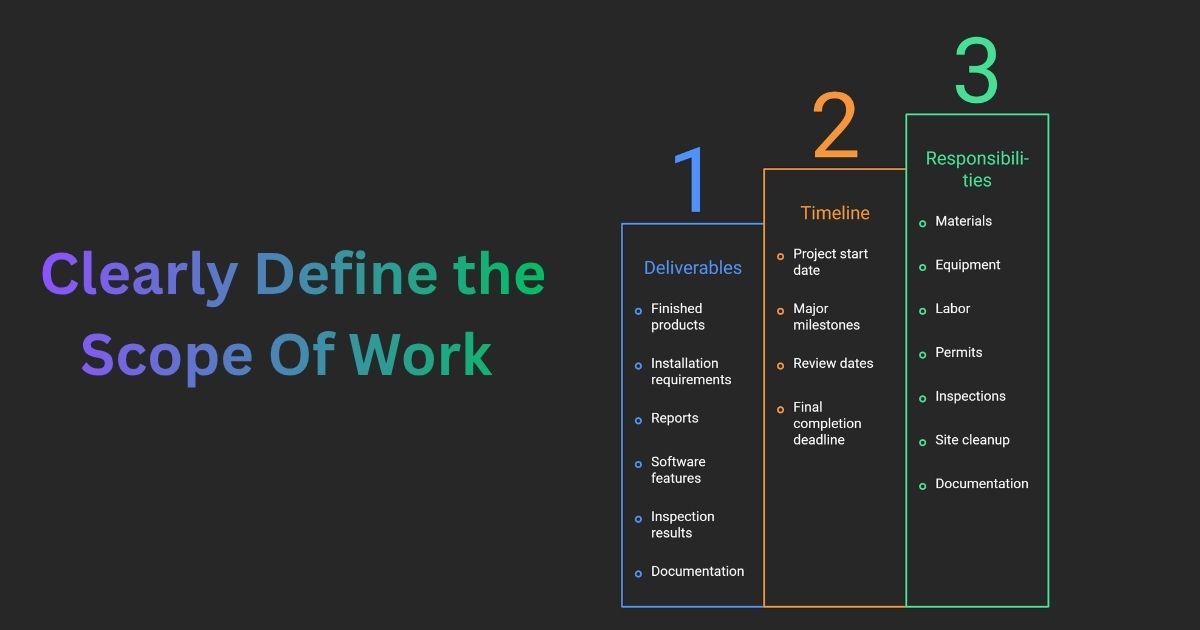
Clearly Define the Scope of Work
Every successful project starts with a well-defined scope of work. If expectations are unclear, misunderstandings, delays, and additional costs become much more likely.
Before contacting contractors, document exactly what you want to accomplish.
Deliverables
List every expected outcome.
Examples include:
- Finished products
- Installation requirements
- Reports
- Software features
- Inspection results
- Documentation
The more specific your deliverables are, the easier it becomes to evaluate proposals.
Timeline
Define realistic milestones.
Include:
- Project start date
- Major milestones
- Review dates
- Completion deadline
A clear schedule keeps everyone accountable.
Responsibilities
Specify who is responsible for:
- Materials
- Equipment
- Labor
- Permits
- Inspections
- Site cleanup
- Documentation
This prevents costly misunderstandings later.
Expert Tip: Ask every contractor to explain the scope back to you. If they interpret it differently, revise your documentation before moving forward.
Set a Realistic Budget
Many businesses underestimate project costs or choose the lowest quote without understanding what is included.
Instead of asking:
“Who is the cheapest?”
Ask:
“Who offers the best value?”
Consider costs such as:
- Labor
- Materials
- Equipment
- Insurance
- Permits
- Travel
- Maintenance
- Contingency expenses
Setting a realistic budget also helps contractors submit more accurate proposals.
Identify Required Skills and Certifications
Not every contractor has the same expertise.
Create a checklist of required qualifications before reviewing candidates.
Examples include:
- Professional licenses
- Trade certifications
- OSHA safety training
- Industry-specific credentials
- Manufacturer certifications
- Software certifications
- Healthcare compliance certifications
The qualifications you require should match your project’s complexity and regulatory requirements.
Verify Contractor Licenses
Never assume a contractor is properly licensed.
Request:
- License number
- Issuing authority
- Expiration date
- Business registration
Then, verify the information through the appropriate government or licensing authority.
Hiring an unlicensed contractor may expose your organization to legal liability, insurance issues, and project delays.
Best Practice: Keep copies of all licenses in your project records for future audits.
Check Insurance Coverage
Insurance protects both your business and the contractor if something goes wrong.
Never rely on verbal confirmation.
Request current certificates of insurance before work begins.
General Liability Insurance
Protects against:
- Property damage
- Third-party injuries
- Accidental damages
Workers’ Compensation Insurance
Helps cover workplace injuries sustained by contractor employees.
Without adequate coverage, businesses may face unexpected legal and financial risks.
Professional Liability Insurance
Especially important for consultants, engineers, architects, designers, and IT professionals.
It covers financial losses resulting from professional errors or negligence.
Checklist
Insurance provider
Policy number
Coverage limits
Expiration date
Review Experience
Experience matters, but relevant experience matters even more.
Instead of asking:
How many years have you worked?
Ask:
- Have you completed similar projects?
- What challenges did you overcome?
- What industries do you specialise in?
- Can you provide measurable results?
A contractor with five years of specialised experience may outperform one with twenty years of unrelated work.
Ask for Previous Projects
A strong portfolio demonstrates real-world capability.
Request examples similar to your own project.
Look for:
- Before-and-after photos
- Case studies
- Client testimonials
- Project timelines
- Performance metrics
- Industry relevance
Ask what challenges occurred and how they were resolved.
This provides valuable insight into the contractor’s problem-solving abilities.
Read Client Reviews
Online reviews reveal patterns that interviews cannot.
Check multiple platforms instead of relying on one source.
Examples include:
- Google Business Profile
- Better Business Bureau (BBB)
- Industry directories
- Professional associations
- Verified review platforms
Look for recurring themes rather than isolated complaints.
Positive indicators include:
- Consistent communication
- Meeting deadlines
- Professional behavior
- Quality workmanship
- Responsive customer service
Verify References
References remain one of the most valuable evaluation tools.
Speak directly with previous clients whenever possible.
Questions to ask include:
- Was the project completed on time?
- Was it completed within budget?
- How did the contractor communicate?
- Would you hire them again?
- Were there unexpected problems?
- How were issues resolved?
Honest conversations often reveal strengths and weaknesses that portfolios cannot.
Evaluate Communication Skills
Poor communication causes many project failures.
Pay attention during the hiring process.
Do they:
- Respond promptly?
- Explain technical information clearly?
- Listen carefully?
- Ask thoughtful questions?
- Follow up professionally?
Strong communication builds trust and reduces misunderstandings throughout the project.
Assess Safety Standards
Safety should never be treated as an afterthought.
Ask contractors about:
- Safety training
- OSHA compliance (or applicable local standards)
- Accident reporting procedures
- Personal protective equipment (PPE)
- Emergency response plans
- Site inspections
Businesses with strong safety cultures often deliver more reliable projects.
Review Compliance Requirements
Compliance varies by industry.
Depending on your project, contractors may need to meet requirements related to:
- Employment laws
- Tax regulations
- Environmental standards
- Data privacy
- Healthcare regulations
- Building codes
- Industry certifications
Failure to verify compliance can expose your organization to penalties and reputational damage.
Confirm Workforce Availability
An excellent contractor isn’t helpful if they can’t start when you need them.
Ask:
- When can work begin?
- How many team members will be assigned?
- Will subcontractors be used?
- Are key personnel available throughout the project?
- Are there other major commitments?
Understanding resource availability helps prevent scheduling conflicts before work begins.
Understand Their Hiring Process
If the contractor provides staffing or labour services, learn how they recruit and screen workers.
Ask about:
- Background checks
- Skills assessments
- Drug screening (if applicable)
- Credential verification
- Reference checks
- Training programs
A structured hiring process often reflects higher-quality workforce management.
Review Equipment and Resources
The right people also need the right tools.
Confirm that the contractor has access to:
- Modern equipment
- Proper machinery
- Technology platforms
- Backup resources
- Transportation
- Safety equipment
Insufficient resources can quickly delay even well-planned projects.
Discuss Project Timeline
Every project should include a realistic schedule—not just a completion date.
Review:
- Key milestones
- Inspection dates
- Approval points
- Material delivery timelines
- Expected completion
- Potential delay risks
Also, ask how schedule changes will be communicated.
Understand Payment Terms
Never assume payment expectations.
Discuss:
- Deposit requirements
- Milestone payments
- Final payment
- Late payment policies
- Change order costs
- Accepted payment methods
Avoid contractors demanding unusually large upfront payments without clear justification.
Review the Contract Carefully
Never sign a contract without reviewing every section.
Scope
Does the contract match the agreed project scope?
Payment
Are payment schedules, taxes, and additional charges clearly explained?
Termination
Can either party terminate the agreement?
Under what conditions?
Confidentiality
If sensitive information is involved, confidentiality obligations should be clearly defined.
Intellectual Property
For software, engineering, design, or creative work, clarify who owns the final deliverables.
Expert Insight: Consider having legal counsel review high-value contracts before signing.
Clarify Change Order Procedures
Almost every project changes.
Establish a formal process before work begins.
Include:
- Written approval requirements
- Cost estimates
- Timeline adjustments
- Authorized decision-makers
Without a documented process, unexpected costs can quickly escalate.
Discuss Communication Frequency
Successful projects depend on consistent updates.
Agree on:
- Weekly meetings
- Progress reports
- Emergency contacts
- Preferred communication channels
- Response time expectations
Regular communication keeps everyone aligned and helps identify issues early.
Plan for Risk Management
Every project involves some level of risk.
Ask the contractor how they handle:
- Weather delays
- Supply chain disruptions
- Equipment failures
- Labor shortages
- Safety incidents
- Unexpected project changes
A contractor with a proactive risk management plan is generally better prepared to keep projects on track.
Confirm Quality Assurance Process
Quality should be measured—not assumed.
Ask about:
- Inspection procedures
- Internal quality checks
- Testing processes
- Documentation standards
- Corrective action procedures
Consistent quality control reduces costly rework and improves long-term results.
Understand Warranty or Service Guarantees
Reliable contractors stand behind their work.
Clarify:
- Warranty duration
- What’s covered
- What’s excluded
- Response times for repairs
- Maintenance responsibilities
Always request warranty terms in writing.
Prepare an Onboarding Plan
A structured onboarding process helps contractors become productive quickly.
Include:
- Site orientation
- Security access
- Safety briefing
- Team introductions
- Documentation requirements
- Reporting procedures
Good onboarding reduces confusion during the first days of the project.
Establish Performance Metrics (KPIs)
Before work begins, define how success will be measured.
Common contractor KPIs include:
- Project completion rate
- On-time milestone achievement
- Budget adherence
- Safety performance
- Quality inspection scores
- Customer satisfaction
- Response times
- Rework percentage
Tracking measurable performance creates accountability and provides valuable insights for future contractor selection.
Contractor Evaluation Scorecard
When you’re comparing several contractors, it’s easy to become overwhelmed by proposals, pricing, and promises. A structured evaluation scorecard helps you compare candidates fairly, using objective criteria rather than relying solely on cost.
This scorecard is especially useful for company owners, procurement teams, HR managers, and project leaders who need a consistent process for selecting contractors. You can assign a score (e.g., 1–5 or 1–10) to each category and compare the final totals before making a decision.
|
Evaluation Criteria |
Importance |
Questions to Ask |
|
Experience |
High | Have you completed projects similar to ours? |
|
Licensing |
High |
Is your license current and verifiable? |
|
Insurance |
High |
Can you provide proof of insurance? |
|
References |
High |
May we contact previous clients? |
| Cost | Medium |
Does the proposal provide good overall value? |
|
Communication |
High |
How often will you provide project updates? |
|
Timeline |
High |
Can you realistically meet our deadline? |
| Safety | High |
What safety standards and training do you follow? |
| Compliance | High |
How do you ensure compliance with applicable regulations? |
|
Quality Control |
High |
What quality assurance process do you use? |
Why Use a Contractor Evaluation Scorecard?
Rather than choosing the lowest bid, this scorecard encourages businesses to evaluate the factors that have the greatest impact on project success.
Contractors with strong communication, compliance, safety practices, and proven experience often deliver better long-term value than those offering the lowest price.
Expert Tip: Create a weighted scoring system. For example, experience, safety, and compliance may each account for 20% of the final score, while price accounts for 10–15%. This helps prevent cost from becoming the only deciding factor.
Red Flags to Watch Before Hiring a Contractor
Even experienced businesses can hire the wrong contractor if they overlook warning signs. Recognising these red flags early can save thousands of dollars, prevent project delays, and reduce legal or compliance risks.
Below are some of the most common warning signs to watch for.
Extremely Low Quotes
A quote that is significantly lower than the others may seem attractive, but it often signals hidden problems.
Possible reasons include:
- Inferior materials
- Inexperienced workers
- Missing project requirements
- Hidden fees added later
- Unrealistic scheduling
- Poor-quality workmanship
Always compare what is included—not just the final price.
No Written Contract
Never rely on verbal agreements.
A professional contractor should provide a written contract that clearly outlines:
- Scope of work
- Timeline
- Payment schedule
- Deliverables
- Warranty
- Responsibilities
- Termination conditions
If a contractor refuses to put agreements in writing, consider it a major warning sign.
Poor Communication
Communication problems usually become worse once the project begins.
Warning signs include:
- Slow responses
- Missed meetings
- Vague answers
- Lack of transparency
- Unclear documentation
A contractor who communicates poorly before signing the contract is unlikely to improve afterwards.
No References
Reputable contractors are proud of their previous work.
If they cannot provide references, project examples, or client testimonials, ask why.
A lack of verifiable experience increases project risk.
No Insurance
Working with uninsured contractors exposes businesses to significant financial liability.
Always request proof of:
- General liability insurance
- Workers’ compensation (where applicable)
- Professional liability insurance (for consulting or design services)
Never assume coverage exists without documentation.
Pressure for Full Upfront Payment
Most professional contractors request reasonable deposits rather than full payment before work begins.
Be cautious if a contractor insists on:
- 100% upfront payment
- Cash-only transactions
- Immediate payment before documentation
A milestone-based payment schedule generally offers better protection for both parties.
Unclear Project Scope
If the proposal contains vague descriptions such as:
- Additional work if needed
- Materials as required
- Timeline to be determined
Request clarification immediately.
Every deliverable should be clearly documented before work starts.
Unrealistic Completion Dates
Promises that sound too good to be true often are.
Experienced contractors understand that projects involve:
- Material lead times
- Weather delays
- Inspections
- Supply chain disruptions
- Permit approvals
Be cautious of contractors who guarantee impossible deadlines without explaining how they will meet them.
Negative Online Reviews
One negative review is not necessarily a deal breaker.
Instead, look for patterns such as:
- Missed deadlines
- Poor workmanship
- Billing disputes
- Safety concerns
- Lack of communication
- Failure to honour warranties
Consistent complaints across multiple review platforms deserve careful investigation.
Expert Insight: During contractor interviews, ask directly about any recurring negative reviews. A transparent contractor will explain what happened and the improvements made.
Contractor vs Staffing Agency: Which Is Better for Your Business?
One of the most common questions businesses ask is whether they should hire an independent contractor or partner with a staffing agency. The answer depends on your hiring goals, project duration, workforce requirements, and level of administrative support needed.
Neither option is universally better. The right choice depends on your business situation.
When Hiring an Independent Contractor Makes Sense
Independent contractors are often the better choice when:
- You need highly specialised expertise.
- The project has a clear beginning and end.
- You can manage the contractor directly.
- The workload is temporary.
- The project requires flexibility.
Examples include:
- Software development
- Engineering consulting
- Facility renovations
- Graphic design
- Equipment installation
- Business consulting
When a Staffing Agency Is the Better Choice
Staffing agencies are ideal for businesses that need multiple workers quickly, as they help reduce administrative responsibilities.
A staffing agency typically handles:
- Candidate sourcing
- Background checks
- Skills assessments
- Payroll administration
- Workforce compliance
- Employee replacement
- Ongoing workforce support
This approach allows internal teams to focus on operations rather than recruitment.
Cost Comparison
Independent contractors may appear less expensive initially, particularly for short-term specialist projects.
However, staffing agencies can provide greater long-term value by reducing:
- Recruitment expenses
- Hiring delays
- Turnover costs
- Administrative workload
- Compliance risks
The lowest hourly rate does not always produce the lowest total project cost.
Compliance Comparison
Worker classification mistakes can lead to legal and tax complications.
When using staffing agencies, many employment-related responsibilities—including payroll processing and workforce administration—are managed by the agency, simplifying compliance for client organisations.
Businesses hiring independent contractors should still verify that worker classification complies with applicable employment and tax regulations.
Hiring Speed Comparison
For urgent hiring needs, staffing agencies generally deploy workers more quickly because they maintain established talent pools.
Independent contractors may require additional time to identify, interview, negotiate, and onboard.
If production stops or staffing shortages affect operations, rapid placement can be a significant advantage.
Risk Comparison
Both options involve risk, but the types differ.
Independent contractor risks may include:
- Worker classification issues
- Limited availability
- Project dependency on one individual
Staffing agency advantages often include:
- Backup candidates
- Workforce continuity
- Structured recruitment processes
- Ongoing account management
Best Option by Business Type
|
Business Need |
Recommended Option |
|
One-time consulting project |
Independent Contractor |
|
Manufacturing workforce expansion |
Staffing Agency |
|
Seasonal hiring |
Staffing Agency |
|
Specialized engineering project |
Independent Contractor |
| Warehouse staffing |
Staffing Agency |
|
Healthcare staffing |
Staffing Agency |
|
Construction consulting |
Independent Contractor |
|
Large-scale workforce recruitment |
Staffing Agency |
Why This Comparison Matters
Business owners, HR managers, procurement professionals, and workforce planners frequently evaluate both options before making hiring decisions.
Understanding the strengths of each approach helps organisations choose the most efficient, compliant, and cost-effective solution based on their operational goals rather than assumptions.
BluebixInc Insight: If your organisation regularly hires warehouse staff, manufacturing workers, skilled trades, administrative professionals, or other contingent talent, partnering with an experienced staffing agency can reduce hiring time, improve workforce flexibility, and simplify day-to-day workforce management.
Best Practices for Managing Contractors Successfully
Hiring the right contractor is only the beginning. The way you manage the relationship can determine whether your project stays on schedule, remains within budget, and meets quality expectations.
Successful contractor management relies on clear communication, accountability, and consistent performance monitoring rather than constant supervision.
Set Clear Expectations
Before work begins, ensure everyone understands the project’s objectives and responsibilities.
Discuss:
- Project goals
- Deliverables
- Deadlines
- Reporting structure
- Decision-making authority
- Success criteria
When expectations are documented from the start, misunderstandings become much less likely.
Use Written Agreements
Every project should have a comprehensive written agreement.
The contract should clearly define:
- Scope of work
- Payment schedule
- Project milestones
- Quality standards
- Change order procedures
- Confidentiality requirements
- Warranty terms
- Termination conditions
Written agreements protect both parties and provide a reference if disagreements arise.
Schedule Regular Progress Reviews
Don’t wait until the project ends to identify problems.
Hold regular check-ins to review:
- Completed work
- Upcoming milestones
- Budget status
- Risks
- Material availability
- Schedule adjustments
Small issues are much easier to solve before they become major delays.
Monitor Key Performance Indicators (KPIs)
Track measurable performance throughout the project.
Useful contractor KPIs include:
- On-time milestone completion
- Budget performance
- Quality inspection results
- Safety incidents
- Customer satisfaction
- Number of change orders
- Rework percentage
- Response time to issues
Data-driven evaluations provide a fair basis for future contractor selection.
Maintain Documentation
Keep organised records throughout the project.
Maintain copies of:
- Contracts
- Licenses
- Insurance certificates
- Change orders
- Inspection reports
- Meeting notes
- Payment records
- Project photographs
Good documentation supports compliance, simplifies audits, and helps resolve disputes if they occur.
Build Long-Term Relationships
Reliable contractors are valuable business partners.
Organisations that consistently work with trusted contractors often benefit from:
- Faster project startup
- Better pricing over time
- Improved communication
- Greater understanding of business expectations
- Higher-quality work
- Reduced hiring effort for future projects
Treat successful contractors as strategic partners rather than one-time vendors whenever possible.
Common Mistakes Businesses Make When Hiring Contractors
Even experienced organisations occasionally make hiring mistakes. Most project problems can be traced back to decisions made before the contract was signed.
Avoid these common errors.

Choosing Based Only on Price
The lowest bid rarely represents the best overall value.
Extremely cheap proposals may indicate:
- Lower-quality materials
- Inexperienced workers
- Hidden costs
- Limited insurance coverage
- Unrealistic schedules
Evaluate experience, quality, safety, and reliability—not just price.
Skipping Background Checks
Never assume a contractor is qualified without verification.
Always confirm:
- Licenses
- Insurance
- Certifications
- References
- Previous projects
- Business registration
Due diligence significantly reduces project risk.
Poor Scope Definition
Vague project requirements often lead to:
- Budget overruns
- Scope creep
- Schedule delays
- Contractor disputes
The more detailed your scope of work, the more accurate contractor proposals will be.
Weak Contracts
A contract should eliminate uncertainty—not create it.
Review every agreement carefully before signing.
Pay particular attention to:
- Payment terms
- Deliverables
- Change order process
- Warranties
- Termination rights
Professional legal review is recommended for high-value projects.
Ignoring Compliance
Businesses sometimes focus on price while overlooking regulatory requirements.
Depending on the industry, contractors may need to comply with:
- Licensing laws
- Safety regulations
- Employment requirements
- Environmental standards
- Data privacy regulations
Ignoring compliance can lead to fines, legal disputes, or project shutdowns.
Lack of Performance Tracking
Many organisations evaluate contractors only after the project ends.
Instead, measure performance throughout the project using KPIs.
Continuous monitoring allows issues to be corrected before they affect quality, cost, or delivery timelines.
FAQ
What should be included in a hiring contractor checklist?
A complete hiring contractor checklist should include project scope, required skills, licenses, insurance verification, references, previous work, pricing, communication expectations, contract terms, compliance requirements, warranties, and performance metrics. Evaluating each area helps reduce risk and improve the likelihood of selecting a reliable contractor.
How do I verify if a contractor is licensed?
Ask the contractor for their license number and verify it through the appropriate state, provincial, or national licensing authority. Many government agencies provide online databases where businesses can confirm license status, expiration dates, disciplinary actions, and business registration information.
Should I always ask for proof of insurance?
Yes. Always request current certificates of insurance before work begins. Verify coverage for general liability, workers’ compensation (where applicable), and professional liability if the contractor provides consulting, engineering, design, or other professional services.
What questions should I ask before hiring a contractor?
Important questions include:
- Have you completed similar projects?
- Can you provide references?
- Are you licensed and insured?
- What is your estimated timeline?
- How do you handle project changes?
- Who will manage the work?
- What warranties do you provide?
These questions help evaluate experience, reliability, and professionalism.
How many contractor quotes should I compare?
Most procurement professionals recommend obtaining at least three detailed proposals. Comparing multiple bids helps identify pricing differences, evaluate project approaches, and understand what each contractor includes in their scope of work rather than selecting based solely on cost.
What is the difference between a contractor and a subcontractor?
A contractor works directly with the client and is responsible for managing the project. A subcontractor is hired by the contractor to complete specialized portions of the work, such as electrical, plumbing, roofing, or painting services.
How do I avoid contractor scams?
Reduce your risk by:
- Verifying licenses
- Confirming insurance
- Checking references
- Reading independent reviews
- Using written contracts
- Avoiding full upfront payments
- Confirming business registration
- Requesting detailed proposals
Careful due diligence is your best defence against fraudulent contractors.
Is hiring a contractor cheaper than hiring employees?
It depends on the project. Contractors often reduce costs for short-term or specialised work because businesses avoid ongoing salaries, employee benefits, payroll taxes, and long-term employment commitments. For permanent, ongoing roles, hiring employees may provide better long-term value.
Should businesses use staffing agencies instead of contractors?
The answer depends on your hiring needs. Contractors are well-suited for specialized project work, while staffing agencies are often the better choice for filling multiple positions quickly, managing seasonal demand, or reducing recruitment and compliance responsibilities.
What documents should every contractor provide before work begins?
Before signing an agreement, request:
- Business registration
- Professional licenses
- Insurance certificates
- Tax documentation (if applicable)
- Project proposal
- Written contract
- References
- Relevant certifications
- Safety documentation
- Warranty information
Keeping these documents on file supports compliance and simplifies future audits.
Conclusion
Hiring the right contractor is one of the most important decisions a business can make. A structured evaluation process helps reduce financial risk, improve project quality, and ensure work is completed safely, on time, and within budget. By following this hiring a contractor checklist, you can compare contractors objectively, verify qualifications, strengthen compliance, and make more confident hiring decisions.
Remember, the lowest quote isn’t always the best investment. Experience, communication, safety standards, and proven performance often deliver greater long-term value than cost alone.
If your business needs reliable workforce solutions beyond independent contractors—whether for manufacturing, warehouse operations, skilled trades, administrative support, or other staffing needs—BluebixInc can help. Our experienced recruitment specialists connect businesses with qualified, pre-screened talent, helping you hire faster, reduce workforce challenges, and keep your operations running smoothly. Contact BluebixInc today to discuss your hiring needs and build a workforce that supports your long-term business growth.
About the Author
BluebixInc Editorial Team
Staffing insights and workforce solutions for employers.