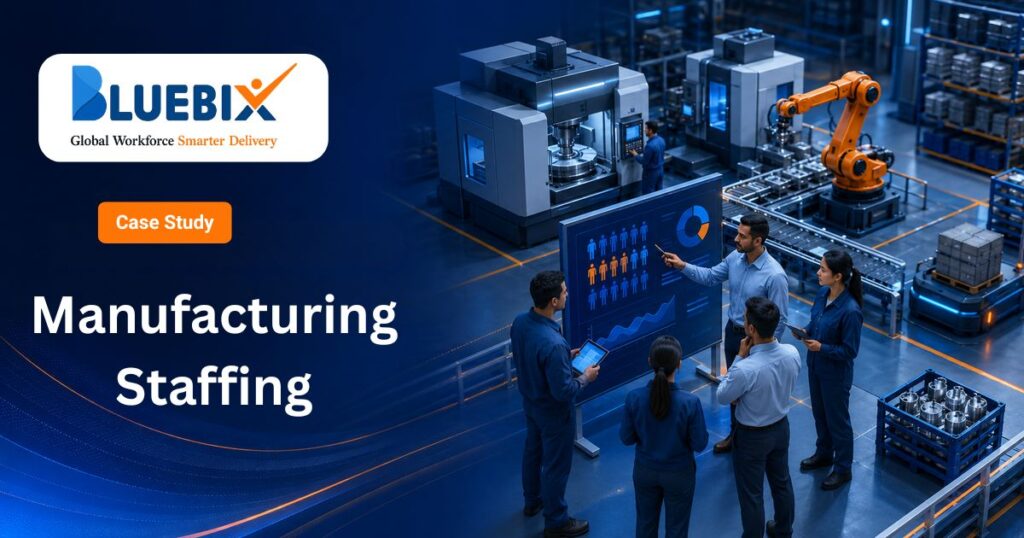
Manufacturing Staffing Case Study: Building a More Reliable Industrial Workforce
A mid-sized U.S. manufacturer of industrial equipment was preparing for seasonal demand and a major production expansion. Its existing hiring process could not keep pace. Skilled positions remained open, overtime increased, and production managers were forced to operate with incomplete teams.
The company partnered with BluebixInc for a coordinated manufacturing staffing strategy covering production, maintenance, quality, engineering, warehouse, and supply chain roles.
Within six weeks, Bluebixinc helped the company fill 40 positions through temporary, contract, and direct-hire staffing. The engagement reduced hiring delays, improved workforce coverage, and gave the client a scalable foundation for future growth.
Need qualified manufacturing talent? Request Manufacturing Staffing Support.
Executive Summary
| Category | Engagement details |
| Client | Operations Director, Industrial Equipment Manufacturer |
| Location | Multiple U.S. production facilities |
| Challenge | Skilled labor shortages, overtime, turnover, and delayed production |
| Staffing objective | Fill 40 operational and technical positions |
| Hiring models | Temporary staffing, contract staffing, and direct hire |
| Initial timeline | Six weeks |
| Six-month result | 95% retention and improved workforce stability |
Bluebixinc combined workforce planning, trade-specific recruiting, technical screening, interview coordination, onboarding, and retention follow-up. The approach focused on operational outcomes—not simply sending resumes to the client.
About the Client
The client operated multiple manufacturing facilities producing industrial equipment for commercial and infrastructure-related customers. Demand increased during certain seasons, but the company also needed permanent employees for expansion, maintenance, engineering, and production supervision.
Its workforce included production operators, machine operators, quality professionals, maintenance technicians, warehouse employees, and engineers. Each position required a different combination of technical ability, safety awareness, reliability, and experience in a production environment.
The company needed a manufacturing staffing agency that could support both immediate production requirements and long-term workforce planning.
The Manufacturing Hiring Challenges
Before working with Bluebixinc, the company faced several connected problems:
- High turnover in production and warehouse positions
- Difficult-to-fill CNC, maintenance, electrical, and engineering roles
- Excessive overtime for existing employees
- Delayed production schedules
- Recruitment bottlenecks across multiple facilities
- Too few qualified applicants
- Long time-to-fill for skilled positions
- Inconsistent candidate screening
- Limited internal recruiting capacity during seasonal demand
The leadership team understood that leaving key positions open created more than an HR problem. It affected production capacity, quality control, employee morale, delivery schedules, and expansion plans.
Bluebix’s Manufacturing Staffing Strategy
Workforce assessment and hiring planning
Bluebix Inc. began with a workforce assessment involving HR, operations, plant leadership, and production managers. Recruiters reviewed open positions, shift schedules, required certifications, pay ranges, hiring deadlines, and facility-specific expectations.
The team then separated positions into three groups:
- Immediate production and warehouse needs
- Skilled technical and maintenance positions
- Long-term direct-hire and leadership roles
This allowed the client to use temporary manufacturing staffing for urgent coverage while building a permanent talent pipeline for critical positions.
Trade-specific recruiting and candidate sourcing
Bluebix used targeted manufacturing recruitment rather than relying only on general job-board applications. Candidate sourcing included:
- Internal database searches
- Passive-candidate outreach
- Employee and industry referrals
- Trade-specific recruiting networks
- Local and regional talent pools
- Previous manufacturing applicant relationships
Recruiters evaluated candidates based on actual job requirements, including machinery experience, shift availability, technical knowledge, safety history, and ability to work in a structured production environment.
Skills testing and interview coordination
Technical candidates completed role-specific assessments before being presented to the client. Depending on the position, screening focused on equipment knowledge, troubleshooting, blueprint reading, electrical systems, CNC experience, quality procedures, or warehouse operations.
Bluebix coordinated interviews between candidates and plant leaders, maintained communication throughout the process, and helped reduce delays between interviews, selection, and offer decisions.
Background verification, onboarding, and compliance
Background verification was handled using consistent, job-related screening criteria. The process was structured with applicable equal-employment requirements in mind, including current EEOC guidance on background checks.
Before placement, Bluebix and the client clarified onboarding responsibilities, documentation, site access, shift expectations, and safety requirements. Employment eligibility procedures were handled according to the applicable employment arrangement and Form I-9 requirements.
Because manufacturing environments can involve machinery and other operational hazards, site-specific safety orientation and job requirements were reviewed before deployment. OSHA explains that machine parts and processes capable of causing injury must be safeguarded.
Retention follow-up
Bluebix continued communication after placement. Recruiters checked attendance, schedule fit, supervisor feedback, onboarding progress, and early performance indicators at defined intervals.
This helped identify concerns before they became preventable turnover issues.
Positions Filled
The engagement covered a broad industrial workforce, including:
- Production operators
- Machine operators
- CNC machinists
- Industrial electricians
- Maintenance technicians
- Quality inspectors
- Production supervisors
- Manufacturing engineers
- Warehouse associates
- Forklift operators
- Material handlers
- Inventory coordinators
- Supply chain specialists
- Automation technicians
- Controls engineers
Recruitment Results
At the six-month review, the anonymized engagement showed the following results:
|
Performance measure |
Result |
|
Positions filled |
40 |
|
Hiring completed |
4 weeks |
| Reduction in time-to-fill |
45% |
|
Reduction in overtime |
30% |
|
Six-month retention |
95% |
|
Attendance rate |
98% |
| Productivity improvement |
22% |
|
Recruitment administration |
Reduced |
| Production continuity |
Improved |
The most important outcome was not the number of hires alone. The client gained better staffing coverage across shifts, reduced pressure on existing employees, and greater confidence in its expansion schedule.
Client Testimonial
“Bluebix understood that our hiring problem was directly connected to production performance. They gave us qualified candidates, kept communication clear, and helped us build a workforce we could depend on.”
— Operations Director, Industrial Equipment Manufacturer
Why Bluebixinc Worked
The engagement succeeded because Bluebix combined:
- Manufacturing and industrial staffing experience
- Dedicated recruiter communication
- Trade-specific candidate sourcing
- Technical and behavioral screening
- Temporary, contract, and direct-hire flexibility
- Structured interview coordination
- Clear onboarding support
- Compliance-aware processes
- Retention follow-up
- Scalable workforce planning
Bluebix’s current manufacturing staffing offering supports production, warehouse, quality, engineering, logistics, maintenance, and project-based workforce needs across the United States. Explore Bluebix manufacturing staffing solutions.
Key Takeaways for Manufacturers
Manufacturers facing workforce shortages should:
- Connect hiring plans to production and expansion goals.
- Separate urgent staffing needs from long-term talent needs.
- Use technical screening for skilled industrial positions.
- Define shift, safety, and performance expectations before recruiting.
- Measure time-to-fill, attendance, retention, and productivity.
- Maintain communication after placement.
- Use temporary and direct-hire staffing together when appropriate.
Frequently Asked Questions
Does Bluebix provide temporary manufacturing staffing?
Yes. Bluebix supports temporary, contract, project-based, temporary-to-hire, and ongoing workforce needs. View temporary staffing services.
Can Bluebix support direct-hire manufacturing recruitment?
Yes. Bluebix provides direct-hire staffing for companies seeking permanent technical, operational, and leadership talent.
How does Bluebix screen manufacturing candidates?
Screening may include experience review, availability checks, role-specific assessments, background verification, interviews, and client-specific requirements.
Can Bluebix support multiple manufacturing facilities?
Yes. Its workforce solutions can be structured for multi-location hiring, seasonal demand, production expansion, and ongoing workforce support.
Conclusion
Manufacturing growth depends on having the right people in the right roles at the right time. When vacancies remain open, the effects can reach production, quality, overtime, delivery, and employee morale.
Bluebix Inc helps manufacturers build dependable workforces through industrial staffing, production staffing, technical recruitment, temporary staffing, direct hire, and workforce planning.
Ready to strengthen your manufacturing workforce? Book a free staffing consultation with BluebixInc.