
Contract Staffing vs Permanent Hiring: Which Fits Your Business?
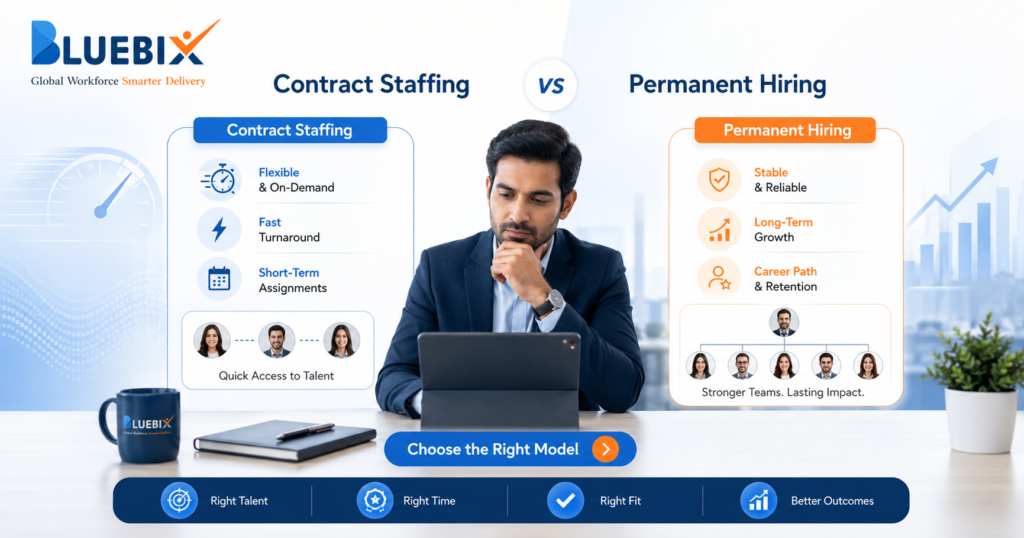
Choosing between Contract Staffing vs Permanent Hiring is not simply an HR decision. It can affect labor costs, project deadlines, productivity, workforce flexibility, and long-term business stability.
Hire permanently for a six-month workload spike, and you may carry more fixed costs than you need. Depend on short-term contractors for a critical leadership role, and valuable knowledge may walk out the door when the assignment ends.
A better decision starts with seven questions:
Demand → Duration → Skills → Speed → Cost → Risk → Strategic importance
This guide will help business owners, HR leaders, production managers, procurement teams, recruiters, and workforce planners decide which hiring model fits the work.
What Is the Difference Between Contract Staffing and Permanent Hiring?
The main difference between contract staffing and permanent hiring is the expected duration and purpose of the employment relationship.
Contract staffing usually helps a business fill a defined, temporary, project-based, seasonal, or flexible workforce need. Permanent hiring is generally designed for ongoing positions that support long-term operations.
What Is Contract Staffing?
Contract staffing gives businesses access to workers for a specific assignment, period, project, or flexible workforce need.
Common reasons include:
- Seasonal demand
- Employee leave
- Production increases
- Project deadlines
- Temporary skills shortages
- New facility or plant expansion
- Technology implementation
- Uncertain future demand
BluebixInc, for example, offers temporary, project-based, contract-to-hire, and flexible contract staffing models for businesses that need to adjust workforce capacity without automatically making every role permanent.
Temporary Staffing
Used for shorter workforce gaps, seasonal peaks, or temporary absences.
Project-Based Staffing
Professionals are hired around a defined project, milestone, or business initiative.
Contract-to-Hire
A candidate starts on a contract assignment with the possibility—not a guarantee—of later becoming a permanent employee.
What Is Permanent Hiring?
Permanent or direct hiring typically means the employee joins the organization in an ongoing role.
It is better suited to positions requiring:
- Long-term ownership
- Leadership
- Organizational knowledge
- Customer continuity
- Career development
- Succession planning
Contract Worker Does Not Automatically Mean Independent Contractor
This distinction matters.
A worker employed through a staffing company can be an employee of that agency. That is different from automatically treating the worker as a self-employed 1099 independent contractor.
The IRS says worker status depends on the real relationship between the worker and business—not simply the title written in a contract.
Contract Staffing vs Permanent Hiring: Quick Comparison
Contract staffing usually works best for temporary demand, urgent workforce gaps, specialized projects, and changing workloads. Permanent hiring usually fits ongoing roles where continuity, institutional knowledge, leadership, and long-term workforce development matter. Neither model is automatically better or cheaper; the right choice depends on the work.
| Factor | Contract Staffing | Permanent Hiring |
| Duration | Defined or flexible | Ongoing |
| Best use | Projects, peaks, temporary gaps | Core long-term roles |
| Workforce flexibility | High | Lower |
| Initial commitment | More flexible | Higher |
| Scaling capacity | Often easier | More structured |
| Specialist expertise | Strong use case | Strong for ongoing needs |
| Institutional knowledge | May be temporary | Builds over time |
| Leadership continuity | Limited for short assignments | Strong |
| Payroll/benefits | Depends on staffing arrangement | Managed by employer |
| Contract-to-hire option | Possible | Not applicable |
| Succession planning | Limited | Strong |
| Long-term development | Assignment-dependent | Usually stronger |
A common mistake is asking:
Which model costs less?
The better question is:
Which model produces the best total workforce value for this specific need?
For example, paying a higher hourly rate for an expert for six months may make more financial sense than hiring a permanent specialist whose skills will not be fully needed after a project ends.
But if your business will require the same capability for the next five years, continuously paying for temporary capacity may no longer make sense.
The decision should follow the work—not a fixed company policy.
Benefits and Trade-Offs of Contract Staffing
Contract staffing works like an adjustable valve. Businesses can increase workforce capacity when pressure rises and reduce it when the need passes.
That flexibility can be especially valuable in construction, manufacturing, logistics, IT, engineering, and project-driven environments.
Faster Workforce Scaling
When production increases or a critical deadline approaches, waiting through a lengthy permanent recruitment cycle may affect output.
Contract staffing can help support situations such as:
- Manufacturing ramp-ups
- Warehouse peak seasons
- Construction projects
- Equipment commissioning
- Software implementation
- Employee leave coverage
Flexibility During Uncertain Demand
Suppose a manufacturer wins a large order that requires six extra production specialists for seven months.
That workload is real, but it may not exist next year.
A flexible staffing model lets the company address today’s demand without assuming it will last forever.
Access to Specialized Skills
Businesses may need expertise such as:
- ERP implementation
- Cybersecurity
- Commissioning engineering
- Quality assurance
- Supply chain analysis
- Project controls
The business may need these skills intensely—but temporarily.
Reduced Internal Recruiting Work
When a staffing partner manages sourcing, screening, candidate coordination, and parts of onboarding, internal HR teams can focus on other workforce priorities.
Trade-Offs to Consider
Contract staffing also has limitations:
- Knowledge may leave when assignments end.
- New contractors need onboarding.
- Repeatedly replacing short-term staff can become inefficient.
- Team integration may require additional effort.
- Managers must plan knowledge transfer.
- The bill rate should be judged against total value, not salary alone.
Candidate preferences matter too. In BLS’s July 2023 data, 48.2% of temporary-help-agency workers said they preferred their arrangement, while 27.7% preferred a different arrangement; others were uncertain. That is a reminder that contract work does not appeal equally to every candidate.
Benefits and Trade-Offs of Permanent Hiring
Permanent hiring is often stronger when the work itself is permanent.
If a position will remain important regardless of one project, customer, season, or contract, building long-term internal capability may create more value.
Build Workforce Stability
Permanent employees can create continuity across changing business conditions.
That matters when a position manages:
- Customers
- Employees
- Vendors
- Production systems
- Safety programs
- Strategic projects
- Company processes
Retain Institutional Knowledge
Experienced permanent employees learn things that are rarely written in a job description.
They know why a process changed, which supplier has caused problems, how equipment behaves, which customers require extra attention, and how different departments work together.
That knowledge becomes organizational capital.
Support Leadership and Succession Planning
Permanent hiring is particularly important for roles such as:
- General manager
- Plant manager
- Operations director
- Engineering leader
- HR leader
- Department manager
- Senior technical expert
Businesses normally want these employees developing teams and making decisions over several years.
Develop Skills Over Time
Training becomes easier to justify when the organization expects an employee to remain and grow.
BluebixInc’s direct-hire service similarly focuses on permanent professionals, passive talent, long-term workforce stability, and reducing the internal hiring burden.
Permanent Hiring Trade-Offs
The model also creates commitments:
- Recruiting may take more time.
- Benefits add to total compensation.
- Onboarding and training require investment.
- Poor hiring decisions can be expensive.
- Reducing headcount is harder than ending planned temporary capacity.
- Permanent hiring may be inefficient for short-lived demand.
Permanent does not mean “better.”
It means the business believes the need will continue long enough to justify deeper commitment.
Contract vs Permanent Employees: What Really Costs More?
This is where many workforce comparisons go wrong.
An employer looks at a contractor’s hourly bill rate, compares it with an employee’s hourly salary equivalent, and concludes the contractor is expensive.
That comparison is incomplete.
Don’t Compare Hourly Rate With Salary Alone
A permanent employee’s salary is only part of total compensation.
BLS reported that in March 2026, private-industry employer costs averaged $32.60 per hour for wages and salaries plus $14.01 for benefits, for total compensation of about $46.60 per hour. In other words, benefits represented roughly 30% of total private-industry compensation costs on average. Actual costs vary significantly by occupation, industry, location, and employer.
Permanent hiring costs may include:
- Salary
- Payroll taxes
- Insurance
- Retirement contributions
- Paid leave
- Recruiting
- Onboarding
- Training
- Equipment
- Vacancy time
- Turnover risk
Contract staffing costs may include:
- Staffing bill rate
- Assignment duration
- Equipment
- Orientation
- Supervision
- Conversion fees, when applicable
- Other contractual charges
Exactly what the bill rate covers depends on the staffing arrangement.
Factor in Vacancy Cost
Suppose a production supervisor vacancy causes overtime, missed output, and extra management workload for 45 days.
A cheaper hiring method that takes three months may actually cost more than a faster method with a higher recruiting or staffing expense.
Think in terms of:
Vacancy duration × business impact
Consider lost production, overtime, delayed projects, team burnout, quality issues, and customer impact.
Compare Duration
Imagine you need a specialist for eight months.
If the expertise will disappear after the implementation, contract staffing may align cost with actual demand.
If the same expertise will be required every week for five years, permanent hiring may create better long-term economics.
Use a Total-Cost Model
A useful comparison is:
Permanent cost = compensation + recruiting + onboarding + vacancy + training + expected turnover cost
versus
Contract cost = total billable assignment cost + onboarding + management + equipment + transition cost
Do not let one hourly number make the decision for you.
Compare Speed, Flexibility, Quality, and Workforce Stability
Cost matters, but four other factors often determine whether the workforce model succeeds.
Speed
Ask:
How quickly must this person become productive?
If a project starts next week or production demand has suddenly increased, speed may carry more value than long-term workforce design.
Flexibility
Ask:
How predictable is the workload?
A distribution center adding workers for holiday demand may value contract staffing.
A distribution manager responsible for year-round operations is more likely to justify permanent hiring.
Quality and Specialized Skills
Do not assume permanent employees are automatically better candidates.
Experienced contract professionals may have deep skills because they have completed similar assignments across multiple organizations.
The more useful question is:
Do we need this expertise temporarily or continuously?
Workforce Stability
Permanent employees generally provide stronger continuity when the company needs ongoing leadership, team development, and relationship ownership.
This becomes important in roles where losing one person also means losing:
- Customer knowledge
- Supplier relationships
- Technical history
- Team trust
- Process knowledge
Knowledge Transfer
Contract staffing works better when the end of the assignment is planned from the start.
For important projects, require:
- Documentation
- Process notes
- Training
- Handover meetings
- System access transfer
- Final project status
- Unresolved issue lists
A good contractor should leave behind more than completed tasks.
They should leave the organization able to continue.
A practical test is:
Urgency + demand volatility + skill scarcity + duration + strategic importance
The more temporary and variable the need, the stronger the contract signal. The more continuous and strategic it becomes, the stronger the permanent signal.
Compliance and Worker Classification: What U.S. Employers Need to Consider
Important: This section provides general workforce information, not legal or tax advice. Employers should consult qualified advisers about their specific circumstances.
Contract Staffing Is Not the Same as 1099 Contracting
This is one of the most important distinctions in the article.
BLS separates several types of alternative work arrangements. Its July 2023 data identified approximately 945,000 temporary-help-agency workers, 862,000 workers supplied by contract firms, and 11.9 million independent contractors on workers’ main or sole jobs. These categories are not interchangeable.
Worker Classification Matters
The IRS says businesses should examine three broad areas when determining whether someone is an employee or independent contractor:
Behavioral Control
Who directs what the person does and how the work is performed?
Financial Control
Who controls important financial and business aspects of the worker’s job?
Type of Relationship
What do contracts, benefits, permanency, and the nature of the work indicate?
There is no single “magic” factor. The full relationship matters.
Safety Responsibilities Still Matter
Companies should also avoid assuming that a staffing agency removes all host-employer responsibility.
OSHA says staffing agencies and host employers share responsibility for providing temporary workers with a safe workplace. OSHA recommends clearly defining responsibilities for training, hazard communication, recordkeeping, and other safety obligations.
This is especially important in manufacturing, warehousing, construction, energy, and other safety-sensitive workplaces.
Procurement Should Review the Arrangement
Vendor management teams should check:
- Contract terms
- Insurance requirements
- Rate structure
- Screening responsibilities
- Safety obligations
- Data access
- Assignment length
- Conversion provisions
- Performance expectations
- End-of-assignment process
A staffing agreement is both a talent decision and a risk-management document.
When Should Your Business Choose Contract Staffing or Permanent Hiring?
The simplest way to choose is to connect the workforce model directly to the business problem.
Choose Contract Staffing When…
Contract staffing often makes sense when:
- Demand is temporary.
- Work is project-based.
- Seasonal volume is increasing.
- A permanent employee is on leave.
- A deadline creates an urgent staffing gap.
- Specialized knowledge is required temporarily.
- Future workload is uncertain.
- You are testing a new function or location.
- Workforce capacity must scale quickly.
Choose Permanent Hiring When…
Permanent hiring usually fits better when:
- The function will continue indefinitely.
- The role is central to daily operations.
- Long-term leadership is needed.
- Institutional knowledge matters.
- Customers or suppliers require continuity.
- Succession planning is important.
- The employee will develop other people.
- The position owns long-term decisions.
Decision Examples by Business Function
Manufacturing
Three-month production increase: Contract staffing may fit.
Plant manager: Permanent hiring is usually more appropriate.
Construction
Project engineer for a defined project: Contract.
Long-term construction operations director: Permanent.
Information Technology
Cloud-migration specialist: Contract may work well.
Head of IT responsible for long-term strategy: Permanent.
Supply Chain and Logistics
Peak-season warehouse capacity: Contract.
Distribution-center manager: Permanent.
Engineering
Commissioning specialist during equipment startup: Contract.
Engineering department leader: Permanent.
Do not turn these examples into rigid rules.
A business may decide differently based on talent supply, geography, project risk, budget, regulatory requirements, and workforce strategy.
The key is asking:
Is the need temporary—or is only our hiring problem temporary?
Those are very different situations.
What About Contract-to-Hire and Hybrid Workforce Models?
The decision is not always contract or permanent.
Many organizations benefit from using both.
What Is Contract-to-Hire?
A contract-to-hire arrangement usually follows this path:
Contract assignment → on-the-job evaluation → possible permanent conversion
BluebixInc includes contract-to-hire among its current contract staffing options.
The model can make sense when:
- A role may become permanent.
- Business demand is still being tested.
- Employers want to evaluate real-world performance.
- The function is new.
- Both sides want time to assess fit.
However, employers should communicate clearly that a conversion is not guaranteed unless it truly is guaranteed.
Candidate discussions on Reddit show how quickly trust can fall when a supposedly permanent role changes into a temporary or contract-to-hire arrangement without clear explanation. Reddit is anecdotal rather than authoritative workforce research, but those discussions highlight a useful employer lesson: state the employer of record, expected duration, benefits, conversion process, and uncertainty clearly from the start.
What Is a Hybrid Workforce?
A hybrid workforce can combine:
Core permanent employees + flexible contract talent
For example, an engineering organization may keep permanent project leaders and internal technical experts while using contract specialists during major installations.
Use a Core-and-Flex Model
A simple rule:
Core work + stable demand + long-term knowledge → Permanent
Variable work + defined projects + temporary expertise → Contract
This approach gives employers stability without forcing every staffing need into the same employment model.
A 7-Factor Framework for Choosing the Right Hiring Model
Recommended word count: 230 words
Before approving the next requisition, answer these seven questions.
How Long Will the Work Exist?
A six-month assignment and a six-year business function should rarely be treated the same way.
How Predictable Is Demand?
Stable volume supports permanent capacity.
Fluctuating volume creates a stronger argument for flexibility.
How Urgent Is the Hire?
Calculate what another 30 days of vacancy may cost the business.
How Specialized Is the Skill?
A highly specialized expert may be valuable for a project but underused afterward.
How Strategic Is the Position?
Roles that own leadership, intellectual capital, long-term client relationships, or important decisions often create a stronger permanent-hiring case.
What Is the Total Workforce Cost?
Include more than salary or bill rate.
What Happens When the Assignment Ends?
Ask this before the worker starts.
Who receives the knowledge? Does the workload disappear? Will another contractor replace them? Will the position probably become permanent?
Use this simple decision matrix:
| Factor | Contract Signal | Permanent Signal |
| Duration | Defined/shorter | Ongoing |
| Demand | Variable | Stable |
| Urgency | Immediate | Planned |
| Expertise | Temporary specialist | Continuous need |
| Flexibility need | High | Lower |
| Knowledge ownership | Limited | High |
| Strategic importance | Project-focused | Core business |
For management teams, this framework creates a better discussion than simply asking HR:
Can we get someone cheaper?
It shifts the conversation toward business value, duration, and risk.
How BluebixInc Supports Both Contract and Permanent Hiring
The right staffing partner should not force every employer into one workforce model.
BluebixInc currently offers temporary staffing, contract staffing, direct hire, project-based staffing, and workforce-planning support.
Start With the Workforce Requirement
A useful staffing discussion should clarify:
- Role
- Skills
- Location
- Timeline
- Assignment duration
- Hiring urgency
- Workforce challenge
- Long-term business objective
Match the Model to the Need
Depending on the situation, the solution may be:
Temporary | Contract | Contract-to-Hire | Project-Based | Direct Hire
Candidate Sourcing and Screening
BluebixInc describes its contract staffing model around targeted recruiting, screening, interview coordination, placement, and ongoing support, while its direct-hire services focus on qualified permanent professionals and long-term workforce stability.
The important question is not simply:
“How many workers do we need?”
It is:
“What talent do we need, how quickly do we need it, and how long will the business need that capability?”
That question creates a better workforce plan.
Not sure whether your next hire should be contract or permanent? BluebixInc can help evaluate the role, hiring timeline, workforce demand, and long-term objective before building an appropriate staffing approach.
Common Mistakes When Choosing Between Contract and Permanent Hiring
Avoid these common workforce-planning mistakes:
- Hiring permanently for temporary demand: Match headcount to expected workload.
- Keeping contractors indefinitely without reassessment: Revisit long-running assignments.
- Comparing hourly bill rate with salary alone: Calculate total workforce cost.
- Ignoring vacancy cost: Slow hiring can damage productivity.
- Confusing staffing employees with independent contractors: Classification matters.
- Choosing solely by budget: Duration, risk, knowledge, and speed matter too.
- Ignoring knowledge transfer: Plan the contractor’s exit before it happens.
- Forgetting the assignment end date: Know what happens next.
- Using one workforce model across every department: A warehouse peak and engineering leadership role have different needs.
- Ignoring candidate preferences: Strong candidates may prefer permanent stability, while others value contract flexibility.
The goal is not to become a “contract-first” or “permanent-first” company.
Become a business-need-first company.
FAQ: Frequently Asked Questions About Contract Staffing vs Permanent Hiring
Is contract staffing cheaper than permanent hiring?
Not automatically. Contract staffing may reduce long-term commitment and can match costs closely to temporary demand, but bill rates may look higher than employee wages. Permanent hiring includes salary plus benefits, payroll-related costs, recruiting, onboarding, training, and possible vacancy or turnover costs. Compare total workforce cost rather than one rate.
What is the main difference between contract staffing and permanent hiring?
Contract staffing generally fills defined, temporary, project-based, or flexible workforce needs. Permanent hiring creates an ongoing employment relationship for long-term business requirements. The practical difference is not only employment duration; it also affects workforce flexibility, institutional knowledge, succession planning, cost structure, and how quickly capacity can change.
When should a company hire contract workers?
Contract staffing can work well when demand is temporary, seasonal, uncertain, project-based, or urgent. It can also help when a business needs specialized skills for a limited period. Before using contractors, define the assignment duration, expected outcomes, supervision, knowledge-transfer process, safety responsibilities, and what happens when the work ends.
Which types of roles should usually be permanent?
Roles are stronger candidates for permanent hiring when they own long-term strategy, leadership, customer relationships, institutional knowledge, team development, or continuous core operations. Examples may include plant managers, department leaders, senior HR leaders, operational managers, and other roles where the organization expects the capability to remain important for years.
Are contract employees the same as independent contractors?
No. A worker supplied through a staffing agency may be an employee of the staffing company rather than an independent contractor. The IRS evaluates worker classification using factors involving behavioral control, financial control, and the relationship between the parties. Employers should not assume that calling someone a “contractor” determines legal status.
Can a contract employee become a permanent employee?
Yes. Contract-to-hire models allow a worker to begin in a contract arrangement and potentially convert to permanent employment later. Conversion should not be presented as guaranteed unless that is truly the case. Employers should communicate expected assignment length, conversion criteria, decision timing, and any relevant contractual provisions clearly.
Is contract staffing faster than permanent hiring?
It can be, especially when a staffing provider already has relevant candidates or when the employer needs temporary capacity quickly. However, speed varies by role, geography, required skills, screening requirements, and labor-market conditions. A highly specialized contractor can still take time to locate, so employers should avoid assuming instant availability.
How long should a contract assignment last?
There is no universal ideal contract length. The assignment should reflect the real business need, project schedule, staffing agreement, and applicable employment requirements. A project may require several weeks, months, or longer. Long-running assignments should be reviewed regularly to determine whether the underlying need has become effectively permanent.
Can a business use contracts and permanent employees at the same time?
Yes. Many businesses can use a hybrid or core-and-flex model. Permanent employees may manage ongoing operations, leadership, and institutional knowledge, while contract professionals support projects, seasonal peaks, specialized skills, or temporary workforce gaps. The key is clearly defining responsibilities, reporting relationships, safety requirements, and knowledge transfer.
How can a staffing agency help choose between contract and permanent hiring?
A staffing agency can help employers evaluate role requirements, hiring urgency, candidate availability, assignment duration, skill scarcity, and workforce goals. It can then recommend contract, temporary, contract-to-hire, project-based, or direct-hire recruiting. Final decisions should still reflect the employer’s financial, operational, compliance, and long-term workforce strategy.
Conclusion — Choose the Workforce Model That Fits the Work
Contract Staffing vs Permanent Hiring should not be treated as a battle between two competing approaches. Both solve different workforce problems.
Contract staffing is often stronger for flexibility, project demand, urgent gaps, seasonal needs, and temporary specialist expertise. Permanent hiring is often stronger for continuity, core operations, leadership, institutional knowledge, and long-term capability.
Before deciding, evaluate:
Demand → Duration → Skills → Speed → Cost → Risk → Strategic importance.
If the answer is still unclear, BluebixInc can help assess the workforce need and determine whether contract, contract-to-hire, project-based, temporary, or direct-hire staffing better fits the role and business objective.
About the Author
BluebixInc Editorial Team
Staffing insights and workforce solutions for employers.