How to Get a Job With No Experience: Complete Guide
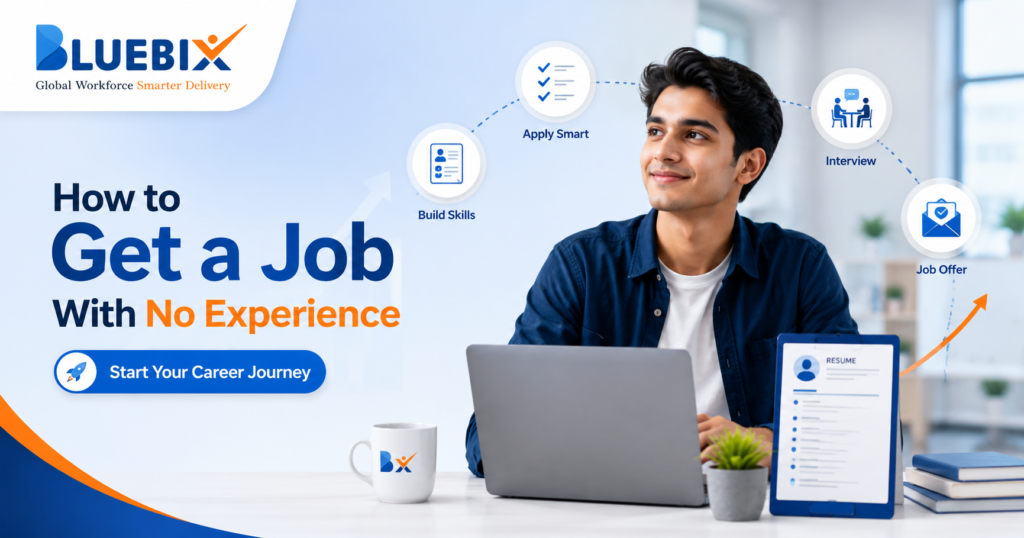
Trying to figure out how to get a job with no experience can feel like being locked outside a door when the key is supposedly inside. Employers ask for experience, but you need someone to hire you before you can build it.
The good news is that “no professional experience” does not mean “nothing valuable to offer.” School projects, volunteering, certifications, personal projects, sports, caregiving, freelance work, and community activities can all provide evidence of useful skills.
Your goal is to follow a practical path:
Choose realistic roles → identify your skills → build proof → create a strong resume → find opportunities → apply strategically → interview well.
Can You Really Get a Job With No Experience?
Yes. People get their first jobs every day without previous professional experience. The key is to target positions designed for new entrants and to demonstrate to employers that you can learn and perform the work.
The U.S. Bureau of Labor Statistics even uses “None” as an official work-experience category for occupations where previous experience in a related occupation is not typically required.
No Experience vs. No Relevant Work Experience
These are not the same thing.
You may already have useful experience through:
- College or school projects
- Volunteering
- Student organizations
- Sports teams
- Freelance tasks
- A family business
- Personal projects
- Caregiving
- Community activities
- Side hustles
What Employers Look for When Experience Is Missing
When your employment history is short, employers have to look for other signals. Those may include skills, reliability, communication, initiative, willingness to learn, and evidence that you can handle relevant tasks.
Stop Measuring Yourself Only by Years of Employment
Your job is not to pretend you have years of experience.
Your job is to demonstrate capability.
That distinction will guide almost every strategy in this article.
Start by Targeting Jobs You Can Realistically Get Without Experience
One of the biggest first-job mistakes is applying randomly.
Instead, identify jobs where employers are realistically prepared to train a new worker.
Look for Entry-Level Jobs That Require No Related Experience
Job titles such as these may signal opportunities for beginners:
Entry-level, junior, trainee, apprentice, assistant, associate, intern, graduate, or technician.
Do not assume the title alone guarantees that experience is unnecessary. Read the requirements.
The BLS Occupation Finder allows job seekers to compare occupations by entry-level education, on-the-job training, projected job growth, and median pay. For example, its current data includes occupations ranging from pharmacy technicians and administrative support roles to apprenticeships in plumbing and other skilled trades.
Read Required and Preferred Differently
If a license is legally required, you cannot simply ignore it.
But if an employer says one year of experience is preferred, while you match the important skills, education, schedule, and other requirements, applying may still be reasonable.
Search for Jobs That Provide Training
Try phrases such as:
- “No experience required”
- “Training provided”
- “Paid training”
- “Entry level”
- “Will train”
- “Trainee”
- “Apprentice”
- “New graduate”
Look Beyond Your First Paycheck
Ask:
Where could this position take me in two or three years?
A modest first role that teaches customer service, equipment operation, data analysis, sales, or technical skills may serve as a bridge to a much stronger second job.
Build Experience Before Someone Gives You Your First Job
The experience problem becomes easier when you stop treating employment as the only way to gain experience.
Use Internships to Gain Workplace Exposure
Internships can help you learn how teams communicate, how deadlines work, how projects are managed, and how professional expectations differ from school.
Focus on internships related to your target field whenever possible.
Volunteer Strategically
Volunteering is more useful when the work aligns with your career goals.
For example:
- Marketing: manage content for a community organization.
- Administration: help organize records or events.
- IT: provide technical support for a nonprofit.
- HR: assist with volunteer onboarding or scheduling.
Do not volunteer simply to write “volunteer” on a resume. Try to produce a measurable result.
Create Your Own Projects
You do not need permission to demonstrate a skill.
A marketing applicant could create a sample campaign. A data candidate could analyze a public dataset. A developer could build a small application. A writer could publish several strong samples.
Use this formula:
Problem → Work performed → Result → Resume evidence
Consider Freelancing or Small Paid Projects
Even a small project for a local organization can give you a real client problem to discuss during an interview.
Explore Registered Apprenticeships
Registered Apprenticeships are particularly useful because they combine employment and learning.
According to Apprenticeship.gov, participants can receive paid work experience, mentorship, progressive wage increases, classroom instruction, and an industry-recognized credential.
That means you can build experience while earning rather than waiting until you feel fully prepared.
How to Write a Resume With No Work Experience
A first-job resume has a different format from an experienced professional’s resume.
You cannot make years of employment appear from nowhere. Instead, your resume should make your relevant skills, education, projects, and achievements easy to see.
Choose a Skills-Forward Resume Structure
A useful structure may be:
- Contact information
- Career objective or short profile
- Relevant skills
- Education
- Projects
- Internship or volunteer experience
- Certifications
- Activities and achievements
CareerOneStop recommends that recent graduates with little or no work experience emphasize education, skills, accomplishments, professional interests, and experiences relevant to the position.
Write a Strong Resume Objective
Use this framework:
Who you are + relevant strengths + target role + value you can provide
For example:
Business graduate with strong Excel, research, and presentation skills seeking an entry-level operations role where I can support reporting, coordination, and process improvement.
Notice what it does not say:
I need a job to gain experience.
Your resume should explain what the employer receives.
Turn Everyday Experience Into Relevant Evidence
| What you did | What an employer may see |
| Organized a college event | Planning and teamwork |
| Managed a student social account | Content and analytics |
| Helped in a family business | Customer service |
| Tutored students | Communication |
| Led a student organization | Leadership |
| Built an Excel tracker | Data organization |
Write Achievement-Based Bullet Points
Avoid:
Helped with student events.
Try:
Coordinated registration for a 150-person student event and helped organize a five-person volunteer team.
Specifics make experience easier to understand.
CareerOneStop also advises focusing work-history descriptions on responsibilities and achievements that relate to the employer’s target position.
Tailor Important Applications
Do not send one generic resume everywhere.
Compare your resume with the job description. Identify the skills and responsibilities you genuinely possess and use the employer’s terminology when it accurately describes your experience.
That can also help applicant-tracking systems assess relevance.
A recent Reddit discussion from a self-described experienced resume screener offered similar practical advice: keep a first-job resume straightforward, emphasize relevant projects and skills, and make accomplishments specific. Treat community advice as anecdotal, but it reflects the same basic principle: clarity beats decoration.
Prove Your Skills When Your Resume Can’t Prove Your Experience
A resume makes claims. Evidence makes those claims believable.
Build a Simple Portfolio
Portfolios are not just for designers.
Depending on your career, you might include:
- Reports
- Presentations
- Spreadsheets
- Writing samples
- Code
- Marketing plans
- Research
- Dashboards
- School projects
- Process documents
Turn Projects Into Mini Case Studies
Use this simple structure:
Problem
What were you trying to solve?
Action
What did you personally do?
Tools
Which software, methods, or skills did you use?
Result
What changed because of your work?
Lesson
What would you improve next time?
That gives an interviewer more to discuss than “I completed an online course.”
Choose Certifications Carefully
Certifications can help when they are recognized by employers in the jobs you want.
Before paying for another certificate, review 20 relevant job postings and count how often employers mention it.
If a credential appears once, it may not deserve months of effort.
If it appears in 14 of 20 openings, that is a much stronger signal.
Build Evidence Before Collecting Credentials
One strong project showing that you can solve a realistic business problem may provide more value than five unrelated certificates.
Think of certifications as labels on the toolbox.
Employers still want to see that you know how to use the tools.
Where to Find Jobs That Don’t Require Experience
The best places to find jobs with no experience include company career pages, government job-search resources, apprenticeship programs, staffing agencies, college career services, job fairs, general job platforms, and organizations offering paid training. Search by both job title and phrases such as “entry level,” “training provided,” and “no experience required.”
Company Career Pages
Once you identify employers you would genuinely like to work for, check their websites directly.
Career pages can reveal openings that fit your location, skills, and schedule.
Job Platforms
Use broad job sites for discovery, but search with specific combinations:
Entry-level + job title + location
or
Trainee + industry + location
The more specific the search, the less time you waste.
Staffing and Recruitment Agencies
Staffing companies can be useful for temporary, contract, contract-to-hire, and permanent opportunities.
They may be particularly helpful for people trying to enter administration, manufacturing, warehousing, logistics, customer service, IT, engineering support, or other fields where employers use recruiters.
American Job Centers and Government Resources
The U.S. Department of Labor recommends CareerOneStop for career exploration, training, job searching, and local assistance. It also directs job seekers to American Job Centers, which can provide employment services such as counseling, job listings, and training referrals.
Apprenticeship Programs
Apprenticeship.gov includes an Apprenticeship Job Finder where career seekers can search by keyword and location, and apply directly to employers or program sponsors.
Colleges and Alumni Networks
If you are a student or graduate, check career offices, alumni networks, employer events, faculty connections, internships, and campus job boards.
Career Fairs
Even when you do not receive an offer immediately, career fairs let you learn which employers hire beginners and what they expect.
Remote Jobs With No Experience
Remote entry-level jobs exist, but competition may be high. Be especially careful with unusually easy “work-from-home” offers. The FTC warns that fake recruiters frequently use promises of remote jobs to steal money or personal information.
Apply Strategically Instead of Sending Hundreds of Applications
More applications do not automatically equal better odds.
Think of your job search as a funnel.
Use a Three-Level Qualification System
Strong match: You meet most essential requirements.
Possible match: You have transferable skills but a few gaps.
Weak match: You lack several critical requirements.
Spend most of your energy on strong and possible matches.
Don’t Reject Yourself Too Early
A preferred qualification is different from a mandatory license or technical requirement.
If you can perform much of the role and demonstrate related skills, consider applying.
Tailor High-Priority Applications
For your strongest opportunities, adjust:
- Resume wording
- Relevant skills
- Project examples
- Career objective
- Cover letter, when useful
CareerOneStop describes a targeted resume as one that makes it easier for an employer to see how the candidate’s qualifications match a particular job.
Track Your Applications
A simple spreadsheet can contain:
Company | Position | Date | Resume version | Contact | Status | Follow-up
Diagnose the Funnel
Here is a useful job-search diagnostic:
Many applications + almost no interviews
→ Review targeting and resume quality.
Several interviews + no offers
→ Review interview answers and how you explain your value.
Very few suitable vacancies
→ Revisit job titles, geography, industry, or missing skills.
Do not solve every problem by submitting more applications.
Fix the stage that is actually failing.
Use Networking When You Don’t Have Professional Connections
Networking does not mean knowing a CEO.
Start with classmates, instructors, alumni, friends, neighbors, former volunteers, relatives, community contacts, and people already working in your target field.
The Department of Labor specifically recommends networking contacts, informational interviews, employer research, job fairs, and job banks as tools for improving employment prospects.
Ask for Information First
Instead of:
Can you get me a job?
Try:
I’m trying to enter the supply chain and noticed you work in the field. I’m learning more about entry-level positions. If you have 15 minutes, I’d appreciate hearing which skills you think new candidates should develop.
That is easier for someone to answer.
Reach Out With a Purpose
Mention why you chose that person and ask one or two specific questions.
Join Relevant Communities
Look at professional associations, alumni groups, industry events, career fairs, local organizations, and online communities.
Networking works best when you treat relationships as conversations rather than transactions.
How to Interview for a Job When You Have No Experience
Your interviewer already has your resume.
You do not need to apologize for something they already know.
You need to demonstrate how your existing experience transfers to the job.
Prepare Evidence for Every Important Skill
If the position requires teamwork, prepare a teamwork story.
If it requires problem-solving, prepare one example of a time you solved a problem.
If it requires reliability, think of evidence from school, volunteering, sports, projects, or responsibilities outside paid employment.
Use the STAR Framework
Situation
What was happening?
Task
What were you responsible for?
Action
What did you do?
Result
What happened because of your actions?
Answer “You Don’t Have Much Experience”
A strong structure is:
Acknowledge → connect skills → provide evidence → show learning ability.
For example:
You’re right that this would be my first formal operations position. During my university project, however, I managed schedules, tracked project data in Excel, and coordinated deadlines for a five-person team. I’m comfortable learning new systems, and I’ve already started studying the tools mentioned in this role.
That is stronger than pretending the gap does not exist.
Answer “Why Should We Hire You?”
Focus on:
Relevant skills + preparation + motivation + evidence + ability to learn.
Do not answer only with enthusiasm. Employers need a reason to believe your enthusiasm can become performance.
Ask Better Questions
Try:
- What would success look like during the first 90 days?
- How are new employees trained?
- Which skills separate strong performers from average performers?
- What would the person in this role need to learn first?
Good questions show that you are already thinking about doing the job, not just getting it.
How to Use AI to Get a Job With No Experience
AI can help organize your job search, but it should not create a fictional version of you.
Use tools such as ChatGPT, Gemini, Claude, Copilot, or similar assistants to:
Understand Job Descriptions
Ask the tool to separate:
Required skills | preferred skills | responsibilities | possible skill gaps
Improve How You Explain Real Experience
For example, provide accurate details about a college project and ask for help turning them into concise resume bullets.
Then verify every statement yourself.
Practice Interviews
Give AI the job description and ask it to act as an interviewer. Practice answering out loud instead of simply reading suggested responses.
Research Career Options
You can compare job titles, identify related roles, generate questions for informational interviews, or organize a learning plan.
BluebixInc AI Job Search Guide follows the same principle: use AI for research, organization, preparation, and practice while keeping real skills and experience at the center of the application.
Never invent employment, certifications, skills, achievements, or projects.
AI can polish the map.
You still have to make the journey.
Common Mistakes to Avoid When Looking for Your First Job
Avoid these common traps:
- Applying only to dream jobs: Your first position can be a stepping stone.
- Using one resume everywhere: Tailor important applications.
- Saying “I have no skills”: Identify transferable skills and prove them.
- Waiting until you meet every preference: Separate essential from preferred qualifications.
- Collecting endless certificates: Build practical evidence too.
- Ignoring temporary work: Contract and temporary roles can create experience.
- Applying to everything: Poor targeting wastes time.
- Giving up after early rejection: Use results to diagnose what needs improvement.
- Trusting suspicious offers: Verify employers before sharing sensitive information or money.
The FTC’s 2026 job-scam guidance warns about unsolicited messages, unusually high pay for simple work, fake checks, task scams, and employers requesting money. A legitimate employer should not require you to pay to get paid.
Rejection can feel personal, but job-search data should be treated like feedback.
Look for the pattern before deciding what to change.
A 30-Day Plan to Get Closer to Your First Job
If you feel overwhelmed, stop thinking about the entire career journey.
Focus on the next four weeks.
Week 1 — Choose Your Target
Select one to three related job families.
Then analyze roughly 20 real job descriptions.
Record:
- Common job titles
- Recurring skills
- Required education
- Preferred experience
- Common software or tools
- Training requirements
You now have your own small labor-market dataset instead of guessing what employers want.
Week 2 — Build Your Evidence
Create or complete one project related to your target role.
Update your resume.
Improve your professional profile.
Ask instructors, volunteer supervisors, or previous project partners whether they can act as references where appropriate.
Week 3 — Apply With Focus
Prioritize strong and possible matches.
Tailor high-value applications.
Search employer career sites.
Visit relevant government career resources.
Contact recruiters where appropriate.
Attend an employer or career event if one is available.
Week 4 — Network, Interview, and Adjust
Review the numbers:
Applications → Responses → Interviews → Offers
Suppose you sent 30 targeted applications and received no interviews. Work on the resume and targeting.
Suppose five interviews produced no offer. Practice interview responses and ask for feedback when appropriate.
The point of the 30-day plan is not to guarantee a job in 30 days.
It is to ensure every week produces evidence, applications, relationships, or information that move you closer.
Can a Staffing Agency Help You Get a Job With No Experience?
Yes, in some cases.
Staffing and recruitment companies can be useful if you are looking for a first professional role, contract assignment, temporary work, career-change opportunity, or a way into a new industry.
What to Expect
A typical process may look like:
Submit resume → recruiter review → skills discussion → job matching → employer interview → offer/onboarding
BluebixInc current careers page describes a similar process: candidates submit a resume, have their profile reviewed, receive interview coordination when matched, and receive support through offer and onboarding. It also offers contract, contract-to-hire, and full-time opportunities.
What a Staffing Agency Cannot Guarantee
No legitimate recruiter can guarantee that every applicant will receive a job.
A recruiting partner can help connect suitable candidates with relevant openings, but employers still make hiring decisions.
For a first-time job seeker, treat staffing support as one additional channel, not your entire job-search strategy.
Frequently Asked Questions About Getting a Job With No Experience
Can I get hired if I have absolutely no work experience?
Yes. Focus on genuinely entry-level positions and show evidence from education, personal projects, volunteering, extracurricular activities, family responsibilities, or other relevant experiences. Employers hiring beginners know candidates may lack formal employment. Your challenge is proving reliability, useful skills, motivation, and the ability to learn the job.
What jobs are easiest to get without experience?
There is no universal “easiest” job. Your location, education, schedule, skills, and local demand matter. Search for entry-level, trainee, apprentice, assistant, customer service, administrative support, manufacturing, logistics, retail, hospitality, and similar positions. Use BLS resources to compare entry requirements before choosing a path.
Should I apply if a job asks for one or two years of experience?
Possibly. First, determine whether experience is truly required or simply preferred. If you meet most of the essential skills and can show strong projects, education, internships, or related experience, applying is reasonable. Do not ignore mandatory licenses, safety requirements, legal qualifications, or genuinely advanced responsibilities just to increase your application count.
What should I put on my resume if I’ve never worked?
Use your education, relevant skills, projects, certifications, volunteer activities, student leadership, achievements, and other evidence that relates to the position. Include measurable details wherever possible. CareerOneStop recommends emphasizing education, skills, accomplishments, and professional interests when recent graduates have little or no traditional work history.
Does volunteer work count as experience?
Yes, especially when you performed tasks relevant to the position. Do not exaggerate it or label unpaid work as paid employment. Instead, clearly identify it as volunteer experience and describe what you accomplished. Managing schedules, assisting customers, organizing events, collecting data, or leading volunteers can demonstrate transferable workplace skills.
How can I prove my skills without a previous employer?
Create proof yourself. Build projects, portfolios, work samples, presentations, spreadsheets, code, reports, case studies, or other outputs related to the job. Use assessments and recognized certifications when relevant. During interviews, explain the problem you addressed, your actions, the tools you used, and the result you achieved.
Do employers actually hire people without experience?
Yes. Some occupations and positions are designed for new entrants to the labor market. BLS formally identifies occupations for which no prior related work experience is typically needed, while others provide short-, moderate-, or long-term on-the-job training. Requirements vary widely, so research the specific occupation rather than assuming every employer expects experience.
Are certifications enough to get an entry-level job?
Usually not by themselves. A relevant certification can show knowledge and commitment, but employers may still want evidence that you can apply what you learned. Combine useful credentials with projects, work samples, internships, apprenticeships, volunteering, or other practical evidence. Choose certifications because target employers value them—not simply to fill your resume.
How can I get experience if nobody will hire me?
Create smaller opportunities first. Consider personal projects, volunteering, freelancing, internships, apprenticeships, community work, student organizations, or supporting a small organization. Registered Apprenticeships are especially useful because they combine paid employment with structured learning. The goal is to create real evidence you can discuss in future applications.
How long should I keep applying before changing my strategy?
Do not rely only on time. Look at your funnel. If many targeted applications generate almost no interviews, review your resume and job selection. If interviews happen but offers do not, focus on interview performance. If relevant vacancies are scarce, broaden the search to include related job titles, locations, industries, or training options.
Conclusion — Your First Job Starts With Proof, Not Years of Experience
Recommended word count: 100 words
Learning how to get a job with no experience is really about learning how to create and communicate evidence.
You cannot manufacture five years of employment. You can identify useful skills, build projects, gain practical exposure, write a targeted resume, develop professional relationships, practice interviews, and improve your strategy using real results.
Think of the process as:
Choose → Learn → Build → Prove → Apply → Connect → Interview → Improve.
If you are ready to explore opportunities, BluebixInc’s career resources include job search, resume, interview, and AI career guides, while its careers platform lets job seekers browse opportunities or join its talent network.
About the Author
BluebixInc Editorial Team
Staffing insights and workforce solutions for employers.