
Staffing Agency for Engineering: Hire Top Technical Talent
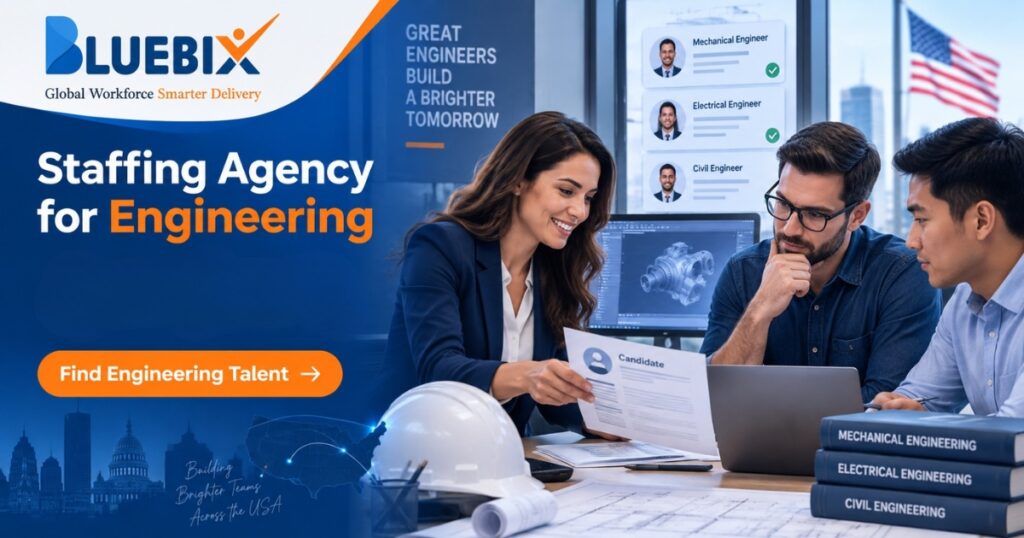
A resume can show the right degree, five software platforms, and ten years of experience, and still belong to the wrong engineer for your project. Choosing a staffing agency for engineering should therefore be about more than finding a company with a large resume database.
For company owners, engineering leaders, plant managers, HR teams, recruiters, workforce planners, and Procurement
This guide explains when to use an engineering staffing firm, how specialized agencies work, how candidates should be technically screened, what staffing models cost, and how to choose a partner that adds real engineering capacity.
1. What Is a Staffing Agency for Engineering?
An engineering staffing agency is a recruiting provider that helps employers identify, source, screen, and hire engineers and related technical professionals.
Depending on the provider, services can include temporary staffing, contract engineering, contract-to-hire, direct hire, project staffing, technical sourcing, and engineering workforce solutions.
The difference between engineering staffing and ordinary recruiting is specialization.
A recruiter may need to understand not only a title such as “Mechanical Engineer” but also:
- The engineering discipline
- Industry
- Product or facility
- Technical tools
- Equipment
- Project phase
- Seniority
- Certifications or licenses
- Shift, travel, and site conditions
What Services Can an Engineering Staffing Agency Provide?
Common solutions include:
- Contract engineering staffing
- Temporary engineering staffing
- Contract-to-hire
- Direct-hire recruitment
- Project-based staffing
- Engineering leadership searches
- Technical candidate sourcing
- Workforce planning support
BluebixInc, for example, currently lists contract staffing, temporary staffing, direct-hire recruitment, project-based staffing, technical talent sourcing, candidate screening, and broader engineering workforce solutions.
Engineering Staffing Agency vs. General Staffing Firm
A general staffing company may recruit across many business functions. A specialized engineering recruiting firm should be able to speak intelligently about engineering disciplines, technologies, projects, technical environments, and relevant credentials.
Engineering Staffing vs. Engineering Recruitment
The terms overlap. “Recruitment” often suggests permanent hiring, while “staffing” commonly includes contract and temporary workers, but agencies use these labels differently.
Focus on Capability, Not the Label
Whether a provider calls itself a recruiter, staffing agency, workforce partner, or talent company matters less than whether it can solve your specific engineering hiring problem.
2. When Should a Company Use an Engineering Staffing Agency?
Companies usually seek an engineering staffing partner when internal recruiting capacity and technical hiring needs no longer align.
A Specialized Engineering Role Is Hard to Fill
Consider this requirement:
Controls Engineer + Allen-Bradley PLC + automated food manufacturing + commissioning experience.
That is very different from simply searching “Electrical Engineer.”
A specialist recruiter can focus on the narrower talent market.
A Project Needs Additional Engineering Capacity
Temporary or contract technical talent may help support:
- Plant expansions
- Equipment installations
- Automation projects
- New production lines
- Construction programs
- Infrastructure work
- Product-development projects
- Commissioning
Internal Recruiting Has Stalled
If the same engineering job remains open after weeks of job-board advertising, another sourcing channel may help reach passive candidates.
An Engineer Leaves Unexpectedly
Engineering departures can affect production support, quality projects, maintenance improvements, customer deliverables, or capital programs.
The Company Is Opening a New Facility
A new site may require engineering talent in a labor market that the internal team does not know well.
Several Engineers Are Needed at Once
Project surges can overwhelm a recruiting team designed for normal hiring volume.
HR Lacks Engineering Recruiting Expertise
Internal recruiters may be strong generalists but lack experience distinguishing between similar technical profiles.
Diagnose the Problem First
Before hiring an agency, ask:
Skills problem? → Sourcing problem? → Capacity problem? → Location problem? → Compensation problem?
A staffing company cannot fix an unrealistic job profile or an uncompetitive offer simply by sending more candidates.
3. What Engineering Roles Can a Staffing Agency Fill?
Engineering staffing should never treat “engineer” as one occupation. Different disciplines solve different problems.
Mechanical Engineers
Mechanical engineers may work in machinery, product development, manufacturing equipment, HVAC, thermal systems, testing, automation, or maintenance.
BLS projects mechanical engineering employment to grow 11% from 2025 to 2035, with about 17,800 openings per year.
Electrical and Electronics Engineers
Possible work includes controls, power systems, electronics, instrumentation, communications, product development, and industrial electrical systems.
Industrial Engineers
Industrial engineers often focus on production efficiency, workflow, logistics, cost reduction, manufacturing systems, automation, and process optimization.
BLS projects 12% growth in industrial-engineer employment from 2025 to 2035 and approximately 23,100 annual openings.
Civil Engineers
Civil engineers work across infrastructure, transportation, water, buildings, site development, and public works. BLS projects about 22,700 openings annually through 2035.
Additional Roles
Depending on the agency, employers may also recruit:
- Manufacturing engineers
- Process engineers
- Quality engineers
- Controls and automation engineers
- Aerospace engineers
- Chemical engineers
- Reliability engineers
- Systems engineers
- Project engineers
- Engineering technicians
- CAD designers and drafters
- Engineering managers and directors
Avoid the “Engineer” Job Description
A stronger profile looks like:
Role + Industry + Project + Equipment/Technology + Seniority
For example:
Manufacturing Engineer + automotive + new assembly line + robotics + five years of plant experience.
That gives a recruiter a search target rather than a generic title.
4. Industrial Engineering Staffing vs. Software Engineering Recruiting
Employers should clarify what “engineering” means before choosing an agency.
Many online engineering staffing lists mix traditional engineering with software development. Those talent markets overlap in some areas, but they are not the same.
Traditional Engineering Staffing
This guide focuses mainly on roles such as:
- Mechanical engineering
- Electrical engineering
- Civil engineering
- Manufacturing engineering
- Industrial engineering
- Process engineering
- Quality engineering
- Controls and automation
- Aerospace engineering
These employees may work with machines, buildings, infrastructure, materials, production systems, plants, physical products, utilities, or industrial processes.
Software Engineering Recruiting
Technology-focused engineering recruitment typically covers:
- Software developers
- DevOps engineers
- Cloud engineers
- AI/ML engineers
- Data engineers
- Platform engineers
The sourcing channels, assessment methods, compensation structures, and work environments can differ substantially.
Where They Overlap
Modern engineering increasingly crosses these boundaries through:
- Embedded systems
- Robotics
- Industrial automation
- Industrial IoT
- Controls
- Digital twins
- Smart manufacturing
Verify What “Engineering” Means to the Agency
When interviewing staffing firms, ask which engineering disciplines account for most of their actual placements.
An agency that excels at software engineering may not be the strongest choice for a manufacturing controls engineer or licensed civil engineer.
5. Contract, Temporary, Contract-to-Hire, or Direct Hire
The right engineer can still be hired through the wrong workforce model.
| Employer situation | Likely staffing model |
| Six-month automation project | Contract |
| Employee leave | Temporary |
| The role may become permanent | Contract-to-hire |
| Ongoing plant engineer | Direct hire |
| Facility expansion | Project staffing |
| Several specialists required | Project/workforce staffing |
| Permanent engineering leader | Direct hire/search |
Contract Engineering Staffing
Contract engineers are useful when specialized expertise is needed for a defined period.
A company may need a controls specialist during installation and commissioning, but not afterward.
Temporary Engineering Staffing
Temporary staffing can cover leave, workload spikes, interim needs, or short-duration technical support.
Contract-to-Hire
This arrangement may create a pathway to permanent employment after an initial contract period.
Conversion should not be presented as guaranteed unless the agreement actually guarantees it.
Direct-Hire Engineering Recruitment
Direct hire usually fits stable positions where the engineering function will remain important over the long term.
Project-Based Staffing
Larger initiatives may need groups of engineers with different specialties for different phases.
BluebixInc currently supports contract, temporary, direct-hire, and project-based engineering staffing models.
Let Duration Shape the Model
Ask:
Will we need roughly the same technical capacity after the project ends?
If the answer is yes, permanent hiring may be a good fit.
If demand ends with the project, a contract model may be more logical.
6. How Does an Engineering Staffing Agency Work?
A strong engineering staffing process begins with understanding the technical work, not opening a resume database.
Define the Requirement
The agency should capture:
- Discipline
- Industry
- Project
- Responsibilities
- Seniority
- Location
- Shift
- Travel
- Start date
- Duration
- Compensation
Separate Candidate Requirements
Divide them into:
Must-Have
Requirements without which the candidate cannot perform the work.
Preferred
Useful but nonessential experience.
Trainable
Internal systems, products, processes, or tools that a capable engineer can learn.
Map the Candidate Market
Recruiters should identify where likely candidates work, what titles they use, and how competitive the talent pool may be.
Source Active and Passive Candidates
Sources can include:
- Existing candidate networks
- Previous applicants
- Referrals
- Direct outreach
- Engineering communities
- Industry networks
- Job platforms
Conduct Recruiter Screening
Confirm experience, interest, compensation, geography, travel, schedule, and basic role alignment.
Perform Technical Evaluation
The method should reflect the engineering discipline.
Present a Shortlist
A useful candidate submission explains not only who the engineer is but also why they meet the requirements.
Employer Technical Interview
Hiring managers validate technical depth, judgment, communication, and real-world experience.
Verification, Offer, and Onboarding
Credentials, licensing, work authorization, background requirements, compensation, start date, and onboarding responsibilities should be clarified.
A Good Submission Explains the Match
A resume alone forces the hiring manager to redo the recruiter’s work.
A strong agency explains:
Candidate experience → Employer requirement → Evidence of fit
7. How Should an Engineering Staffing Agency Screen Candidates?
Engineering screening should test evidence, not buzzwords.
Screen Against the Engineering Problem
Instead of asking:
“How many years have you been an engineer?”
ask:
“What similar technical problems have you solved?”
Assess Discipline-Specific Knowledge
Mechanical, electrical, civil, manufacturing, quality, and controls candidates should not receive identical evaluations.
Examine Project Experience
Ask candidates to explain:
- The project objective
- Their responsibility
- Technical constraints
- Tools used
- Scale
- Decisions made
- Failures or setbacks
- Final result
Evaluate Tools in Context
Examples may include:
- SolidWorks
- AutoCAD
- Revit
- MATLAB
- BIM
- PLC platforms
- MES
- ERP
- Simulation software
- Statistical tools
The key question is not “Do you know SolidWorks?”
Ask:
“What did you design with it, and what decisions were you responsible for?”
Use Technical Scenarios
For manufacturing:
“Scrap is increasing while line output is dropping. What information would you investigate first?”
For mechanical design:
“A component repeatedly fails fatigue testing. How would you structure the investigation?”
Practitioner discussions on engineering-focused Reddit communities repeatedly show technical interviews built around actual drawings, GD&T, manufacturing methods, analysis, and real project experience rather than generic behavioral questions alone.
These accounts are anecdotal, but they illustrate how role-specific technical evaluation works in practice.
Assess Communication
Engineers frequently communicate with:
Production + Maintenance + Quality + Vendors + Customers + Management
Technical expertise without clear communication can slow decisions.
Verify Project Scale
An automation project can refer to a single workstation or a multi-site manufacturing program.
Ask for the scope.
Candidate Scorecard
| Candidate factor | Suggested weight |
| Technical competence | 25% |
| Industry relevance | 20% |
| Similar project experience | 15% |
| Problem solving | 10% |
| Technical tools | 10% |
| Communication | 10% |
| Availability/location | 5% |
| Assignment-specific factor | 5% |
This is a BluebixInc editorial framework, not an official industry standard.
Score Evidence, Not Keywords
A candidate listing “PLC” is not automatically equivalent to someone who has programmed, commissioned, debugged, and supported automated equipment.
8. Engineering Licenses, Credentials, Safety, and Verification
Engineering qualifications can involve more than education and experience.
Education Verification
Many professional engineering roles typically require an engineering degree or related technical education, although requirements vary by discipline and employer.
Professional Engineer Licensure
There is no single nationwide PE license.
NCEES explains that candidates should verify requirements in the state or territory where they plan to practice. A commonly accepted pathway includes qualifying education, progressive experience, the FE exam, and the PE exam, although state rules can differ.
When PE Licensure May Matter
Licensure may be relevant when work involves circumstances such as:
- Signing or sealing engineering documents
- Public-facing engineering services
- Certain consulting work
- Government contracts
- Jurisdiction-specific regulated practice
Requirements should be checked for the actual role.
Other Certifications
Depending on the job, employers may value or require:
- Quality certifications
- Project-management credentials
- Safety credentials
- Industry-specific training
- Vendor certifications
Security Clearance
Some aerospace and defense roles may require an active or obtainable security clearance.
Site and Employment Requirements
Employers may also need to verify:
- Work authorization
- Background requirements
- Drug-screen policies
- Site access
- Safety training
- Customer-specific qualifications
Staffing Screening Does Not Replace Employer Verification
The staffing provider can support verification, but employers should retain responsibility for final technical, licensing, safety, regulatory, and hiring decisions.
9. What Does the U.S. Engineering Hiring Market Look Like?
Engineering hiring is active, but broad claims about a universal U.S. “engineer shortage” oversimplify the market.
The Bureau of Labor Statistics projects architecture and engineering occupations to grow much faster than the average for all U.S. occupations between 2025 and 2035. About 174,800 openings per year are projected across the group, from both employment growth and workers permanently leaving occupations.
The median annual wage for the group was $99,520 in May 2025, compared with $50,980 for all occupations.
Selected Engineering Hiring Activity
BLS currently projects:
- Industrial engineers: 12% growth; 23,100 annual openings
- Mechanical engineers: 11% growth; 17,800 annual openings
- Civil engineers: 6% growth; 22,700 annual openings
Combined, those three disciplines alone represent about 63,600 projected openings per year, roughly 36% of the broader 174,800 annual architecture-and-engineering openings. That percentage is an editorial calculation based on current BLS projections, not a separate BLS statistic.
Why Replacement Hiring Matters
Annual openings are not the same as newly created positions.
BLS notes that openings also occur when workers transfer occupations or leave the labor force.
Avoid Unsupported Shortage Claims
A more credible statement is:
Engineering hiring difficulty varies by discipline, geography, industry, skill combination, compensation, and project requirements.
A controls engineer in Wisconsin, a PE civil engineer in Texas, and an aerospace engineer with clearance in California belong to different talent markets.
10. Local, National, Remote, and Multi-Site Engineering Staffing
Geography should be part of the engineering profile from the start.
Local Recruiting
Local candidates are often important for:
- Manufacturing plants
- Construction sites
- Commissioning
- Field engineering
- Operations
- Equipment support
Nationwide Engineering Recruiting
A national search may make sense for highly specialized or senior positions where the local pool is limited.
That introduces additional variables:
- Relocation
- Compensation differences
- Travel
- Start timing
Remote Engineering Roles
Some work can be performed remotely, particularly:
- Design
- Modeling
- Documentation
- Analysis
- Systems work
- Software-heavy technical functions
Other jobs require physical access to machinery, construction sites, laboratories, utilities, or production lines.
Hybrid Engineering Staffing
Hybrid models can work where engineers need both design flexibility and periodic on-site presence.
Multi-Site Hiring
Large manufacturers, infrastructure companies, utilities, and construction organizations may need engineering talent across several states or facilities.
Specify Travel
Do not write “some travel.”
Define:
- Percentage
- Region
- Frequency
- Overnight expectations
Geography Is a Job Requirement
“Engineering Manager in Ohio” and “Engineering Manager based in Ohio with 70% nationwide travel” represent two very different recruiting assignments.
The staffing agency should know that before sourcing begins.
11. Project and High-Volume Engineering Staffing
Large engineering programs should be staffed based on project phases, not only on headcount targets.
Start With the Project Schedule
Use this workforce-planning framework:
Project Phase → Technical Work → Skill → Headcount → Start Date → Duration
Design Phase
Possible requirements:
- Design engineers
- CAD specialists
- Mechanical engineers
- Electrical engineers
- Civil engineers
- Process engineers
Implementation Phase
The team may shift toward:
- Project engineers
- Controls engineers
- Manufacturing engineers
- Field engineers
- Construction engineering
Commissioning Phase
Demand may move toward:
- Commissioning engineers
- Validation professionals
- Controls specialists
- Quality engineers
- Test engineers
Operations Phase
After launch, the workforce might shift again:
- Industrial engineers
- Reliability engineers
- Process engineers
- Maintenance engineering
- Continuous-improvement specialists
Separate Permanent Capacity From Project Capacity
Imagine a manufacturer with eight permanent engineers preparing a major expansion.
For 12 months, it needs five additional controls and project engineers.
That does not automatically mean the company needs 13 permanent engineers forever.
Recruit in Waves
A useful sequence may be:
Design → Installation → Commissioning → Operations
Build Backup Pipelines
Critical projects are vulnerable if one specialized engineer rejects an offer or leaves early.
Recruiters should identify alternatives before the project reaches a critical point.
Coordinate Recruiting With Project Management
Hiring plans must move when project schedules, budgets, or technical scopes change.
Plan Ramp-Down
Contract workforce exits should be planned as carefully as onboarding.
Headcount Does Not Equal Engineering Capacity
Five highly experienced specialists can sometimes contribute more useful project capacity than ten generalists.
Plan around:
Skill + Experience + Productivity + Workload + Timing
rather than headcount alone.
12. How Much Does a Staffing Agency for Engineering Cost?
There is no credible universal engineering staffing markup.
Costs vary because engineering hiring itself varies.
Factors Affecting Cost
These can include:
- Engineering discipline
- Seniority
- Industry
- Location
- Certifications
- Licensure
- Travel
- Shift
- Talent availability
- Assignment length
- Staffing model
- Screening requirements
Contract Staffing Cost
A contract bill rate may generally reflect:
Engineer compensation + employment-related costs + recruiting/administration + agency margin
Actual terms depend on the agreement.
Direct-Hire Recruiting
Permanent placement fees usually use a different structure because the candidate becomes the client’s employee.
Project and SOW Pricing
Pricing may differ again when a provider supplies a team or commits to defined project deliverables rather than only individual workers.
Current Engineering Wage Context
BLS reports May 2025 median annual pay of:
- Mechanical engineers: $104,110
- Industrial engineers: $102,440
- Civil engineers: $100,840
These are national occupational wage benchmarks—not staffing bill rates or recommended salaries for every U.S. market.
Compare Agency Cost With Vacancy Cost
An unfilled engineering position may create indirect costs through:
- Project delays
- Manager coverage
- Overtime
- External consultants
- Equipment downtime
- Production problems
- Delayed product launches
- Internal recruiting hours
A useful internal estimate is:
Vacancy burden = diverted internal hours + overtime + outside support + identifiable project-delay costs
That is an employer planning framework, not a standardized industry formula.
Lowest Rate Does Not Mean Lowest Total Cost
Compare:
Bill Rate + Technical Quality + Supervision + Ramp Time + Productivity + Project Impact
A cheaper engineer requiring constant correction can be more expensive than a stronger contractor at a higher rate.
13. How to Choose the Right Staffing Agency for Engineering
The best engineering staffing provider is not necessarily the largest agency or the one promising the fastest shortlist.
Look for evidence.
Confirm Engineering Specialization
Ask what percentage of the company’s recruiting activity is engineering or technical talent.
Ask Which Disciplines They Recruit
A strong response should be specific:
- Mechanical
- Electrical
- Civil
- Industrial
- Manufacturing
- Quality
- Process
- Controls
- Aerospace
Review Industry Experience
A mechanical engineer seeking a role in aerospace is different from one seeking a role in food manufacturing.
Ask How Candidates Are Sourced
Does the provider rely solely on job applications, or does it also use direct outreach, referrals, existing networks, and passive sourcing?
Ask How Technical Ability Is Evaluated
Do not accept:
“All candidates are pre-vetted.”
Ask what that actually means.
Review Staffing Models
Can the agency support:
- Contract
- Temporary
- Contract-to-hire
- Direct hire
- Project staffing
Check Geographic Reach
“Nationwide” should mean the agency can realistically recruit in the markets where you need talent.
Review Project Scalability
Can the firm recruit one engineer and also scale for a larger project?
Clarify Verification
Ask who is responsible for:
- Education
- Licenses
- Certifications
- Work authorization
- Background screening
- Customer-specific requirements
Review Account Management
Know who owns communication after the contract is signed.
Compare Commercial Terms
Procurement should understand bill rates, overtime, conversion terms, replacement policies, cancellation, invoicing, insurance, and assignment requirements.
10 Questions to Ask
- Which engineering disciplines do you recruit most?
- Which industries do you know best?
- How do you assess technical skills?
- Who performs the screening?
- How do you reach passive candidates?
- Do you support contract and direct hire?
- What is your geographic coverage?
- Can you scale for projects?
- What does pricing include?
- Which performance metrics do you report?
14. Engineering Staffing Agency Evaluation Scorecard
A scorecard helps HR, Procurement, and engineering leaders compare providers using the same criteria rather than relying on presentation quality or brand recognition.
The following is a BluebixInc editorial framework, not an official staffing-industry standard.
| Agency factor | Suggested weight |
| Engineering specialization | 20% |
| Candidate quality | 20% |
| Technical screening | 15% |
| Relevant industry experience | 10% |
| Talent-network reach | 10% |
| Responsiveness | 10% |
| Pricing transparency | 5% |
| Project scalability | 5% |
| Reporting/support | 5% |
| Total | 100% |
Score Each Vendor Consistently
Use:
1 = weak
3 = acceptable
5 = strong
Then apply the weighting.
For example, if technical screening carries 15% of the evaluation, a provider that cannot explain its technical assessment should lose meaningful points.
Adjust the Weighting for the Role
Aerospace
Increase weight for:
- Industry experience
- Clearance capability
- Credentials
- Quality systems
Manufacturing
Increase:
- Plant experience
- Production knowledge
- Equipment understanding
- Process engineering
Civil and Infrastructure
Increase:
- Project experience
- Licensure relevance
- Regulatory knowledge
High-Volume Projects
Increase:
- Scalability
- Responsiveness
- Candidate pipeline depth
Use Evidence, Not Brand Recognition Alone
A large agency may offer greater scale.
A specialist agency may understand a niche discipline better.
A regional provider may have a stronger local candidate market.
The right question is not:
“Which staffing company is biggest?”
It is:
“Which provider best fits this engineering hiring problem?”
15. Quick Comparison: 7 Engineering Staffing Agencies in the USA for 2026
For employers seeking a starting point, the following companies represent distinct strengths in engineering recruiting.
This is an editorial shortlist, not an absolute ranking. “Best” depends on your engineering discipline, location, project, staffing model, and hiring volume.
Because this article is published for BluebixInc and includes BluebixInc, readers should consider that commercial relationship when evaluating the comparison. The other providers are included based on publicly available information about engineering specialization, staffing models, market coverage, and service capabilities.
| Agency | Best suited for | Key engineering strength |
| Actalent | Large-scale engineering staffing | Broad engineering specialization and scale |
| Randstad | Enterprise and EPC hiring | Engineering/design and major project recruitment |
| BluebixInc | Flexible multi-industry staffing | Contract, temporary, project, and direct hire |
| Kelly Engineering | Contingent engineering programs | Specialized engineering staffing at scale |
| Insight Global | Broad discipline coverage | Contract and permanent engineering hiring |
| KORE1 | Specialized/niche engineering | Discipline-focused technical recruiting |
| NES | FircroftEnergy | Major technical projects; global engineering contract workforce |
Actalent — Strong for Engineering Staffing at Scale
Actalent describes itself as a specialized provider of engineering and scientific talent. Its engineering staffing coverage includes manufacturing, mechanical, electrical, architecture, environmental, civil, construction, systems, software, transmission, distribution, and power.
Its site also cites recognition from Staffing Industry Analysts as the largest U.S. engineering staffing firm.
Best suited for: employers that value broad engineering specialization and large-scale delivery.
Randstad — Strong for Enterprise, Manufacturing, and EPC Hiring
Randstad’s engineering and design operations recruit for roles across aerospace, manufacturing, mechanical, electrical, process, controls, project, automation, quality, CAD, and related disciplines.
Its EPC practice also supports civil, structural, chemical/process, construction, project controls, and permanent or contract hiring.
Best suited for: large engineering programs, EPC environments, manufacturing, and multi-role workforce needs.
BluebixInc — Strong for Flexible Multi-Industry Engineering Staffing
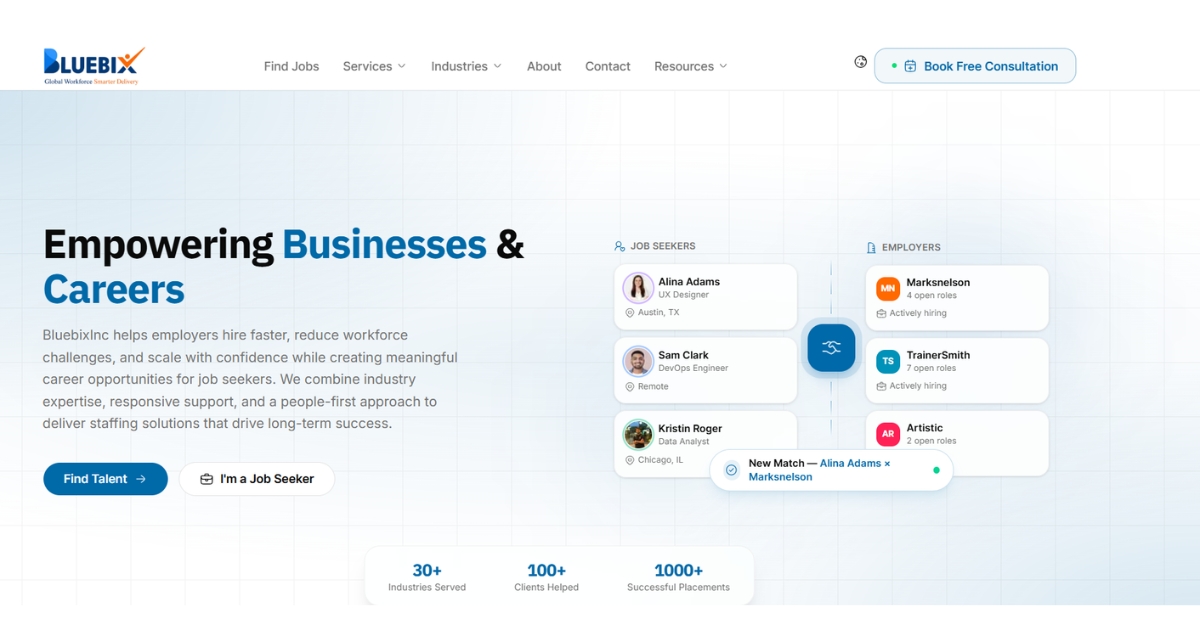
BluebixInc supports engineering staffing across manufacturing, construction, infrastructure, energy, industrial operations, automotive, aerospace, supply chain, telecommunications, and automation.
Its current models include contract, temporary, direct hire, project-based staffing, technical sourcing, and candidate screening.
Best suited for: employers that need flexible staffing across industrial and project-driven engineering environments.
NES Fircroft — Strong for Energy and Major Engineering Projects
NES Fircroft specializes in contract recruitment across engineering-heavy sectors, including oil and gas, power, renewables, and life sciences.
It reports supporting more than 25,000 contractors globally on technical engineering assignments.
Best suited for: energy, power, major capital projects, and global engineering workforce programs.
Kelly Engineering — Strong for Contingent Engineering Solutions
Kelly Engineering was named a Leader and Star Performer in Everest Group’s 2026 U.S. engineering contingent talent assessment and reported maintaining a No. 4 ranking among U.S. engineering staffing firms from Staffing Industry Analysts.
Its coverage includes aerospace, automotive, energy, advanced manufacturing, semiconductors, life sciences, and related engineering markets.
Best suited for: large contingent engineering programs and specialized workforce solutions.
Insight Global — Strong for Broad Engineering Discipline Coverage
Insight Global recruits across aerospace, biomedical, chemical, civil, electrical, industrial, mechanical, process, semiconductor, and systems engineering and offers contract, contract-to-permanent, and permanent models.
Best suited for: employers hiring across multiple engineering disciplines through a single staffing partner.
KORE1 — Strong for Specialized Engineering Searches
KORE1 currently markets staffing across mechanical, electrical, civil, manufacturing, systems, embedded, MEP, aerospace, semiconductor, automation, and other technical disciplines using contract, contract-to-hire, and direct-hire models.
Best suited for: niche engineering and specialized regional searches.
16. Procurement and Contract Checklist for Engineering Staffing
Procurement should evaluate more than the agency’s markup or fee.
Review Pricing Structure
Understand what is included and what may generate extra charges.
Clarify Bill Rates and Pay Rates
Where relevant, determine how worker pay relates to the client bill rate.
Review Overtime
Know:
- When overtime begins
- Which multiplier applies
- Who approves it
Check Conversion Terms
If a contract engineer may become a permanent employee, understand conversion fees and timing.
Review Replacement Provisions
What happens if a permanent hire leaves shortly after starting?
Check Cancellation Terms
Especially for project and contract workers.
Clarify Insurance
Requirements can differ by client, site, and workforce model.
Define Screening Responsibilities
Document which party handles:
- Background checks
- Drug screens
- Licenses
- Credentials
- Work authorization
- Site qualifications
Address Worker Classification
Do not assume every contractor uses the same employment structure.
Clarify Safety Responsibilities
Engineering contractors entering industrial sites need clearly defined safety processes.
Protect Confidentiality and Intellectual Property
Engineers may gain access to:
- Product designs
- Drawings
- Trade secrets
- Manufacturing processes
- Test data
- R&D information
Contracts should address confidentiality and IP appropriately.
Set Reporting and Escalation Expectations
Define account ownership and what happens if a contractor underperforms.
Compare Scope, Not Just Rate
A higher bill rate may include payroll administration, stronger screening, compliance support, replacement services, or dedicated account management.
Compare equivalent services before deciding which proposal is cheapest.
17. Red Flags When Choosing an Engineering Staffing Agency
Certain warning signs suggest an agency is focused on volume rather than technical fit.
Watch for providers that:
- Send resumes before understanding the engineering problem
- Cannot explain their technical screening process
- Treat mechanical, electrical, civil, and controls roles the same
- Call every candidate “pre-vetted” without defining the term
- Cannot explain what has actually been verified
- Match candidates mainly on software keywords
- Promise unrealistic hiring timelines
- Avoid detailed pricing questions
- Cannot explain contract-to-hire conversion terms
- Have little knowledge of your industry
- Cannot discuss licensing when it matters
- Lacks the geographic reach required
- Provide no clear escalation contact
- Measure success only by resumes submitted
- Stop communicating once a contractor starts
More Candidates Can Mean More Work
Suppose Agency A submits 25 engineers, and only two are relevant.
Agency B submits five, and four are interview-worthy.
Agency A produced more activity.
Agency B produced more signal.
Every weak resume consumes hiring manager time. For technical leaders already managing projects, unnecessary screening carries a real opportunity cost.
Recruiting productivity should therefore be measured by the quality of qualified candidates, not by submission volume.
18. How BluebixInc Supports Engineering Employers
BluebixInc currently provides engineering staffing support across manufacturing, construction, infrastructure, energy and utilities, industrial operations, automotive, aerospace, logistics and supply chain, telecommunications, and technology and automation.
Define the Requirement
A targeted engineering search should start with:
Industry → Discipline → Project → Skills → Experience → Location → Duration
Technical Talent Sourcing
Candidate outreach can then focus on professionals with relevant engineering backgrounds rather than on generating broad application volume.
Candidate Screening
BluebixInc currently lists candidate screening and evaluation as part of its engineering staffing offering.
Flexible Staffing Models
Available engineering workforce models listed by BluebixInc include:
Contract | Temporary | Direct Hire | Project-Based Staffing | Workforce Solutions
The company also positions its engineering services around production operations, manufacturing facilities, infrastructure projects, maintenance planning, process optimization, quality assurance, supply-chain operations, and technical support.
If an engineering vacancy, plant expansion, technical project, or difficult skill requirement is slowing the business, BluebixInc can help employers define the requirement and develop a focused recruiting approach around the work that needs to be completed.
19. FAQ — Staffing Agency for Engineering
What does a staffing agency for engineering do?
An engineering staffing agency helps employers identify, source, screen, and hire technical professionals. Depending on the firm, services may include temporary staffing, contract engineering, contract-to-hire, project staffing, permanent recruitment, candidate screening, and workforce planning for mechanical, electrical, industrial, civil, manufacturing, and other engineering disciplines.
What types of engineers can an engineering staffing agency recruit?
Engineering recruiters may source mechanical, electrical, industrial, civil, manufacturing, process, quality, controls, automation, aerospace, chemical, systems, reliability, and project engineers. Some providers also recruit CAD professionals, technicians, engineering managers, and technical leaders. Employers should confirm that the agency regularly recruits the exact discipline they need.
How does an engineering staffing agency evaluate technical skills?
Strong screening can include reviewing relevant projects, engineering discipline knowledge, technical tools, scenario-based questions, project scale, problem-solving approach, communication skills, certifications, and work samples, where appropriate. Recruiters should connect candidate evidence to the job, while the employer’s engineering team should retain responsibility for the final technical assessment.
Can an engineering staffing agency provide contract engineers?
Yes. Contract engineers can support defined projects, temporary capacity, equipment installations, plant expansions, automation programs, commissioning, design work, or specialized technical assignments. The employer should clearly define project duration, duties, location, rate structure, supervision, onboarding, and any conversion terms before the assignment begins.
Can I hire permanent engineers through a staffing agency?
Yes. Many engineering staffing firms also offer direct-hire recruiting. Permanent hiring is often appropriate when engineering work is stable, recurring, and central to long-term operations. Contract staffing may fit better when demand is tied to a temporary project, an uncertain workload, or a specialized short-term requirement.
How fast can an engineering staffing agency fill a position?
There is no responsible universal hiring timeline. Speed depends on engineering discipline, experience level, industry, geography, compensation, travel requirements, licensing, work model, candidate availability, screening requirements, and the competitiveness of the labor market. A precise job specification usually enables a more efficient search than a broad one.
Does every engineering candidate need a PE license?
No. PE requirements depend on the role, engineering activity, and jurisdiction. NCEES explains that candidates should verify licensing requirements in the jurisdictions where they intend to practice, and that the common path generally involves education, experience, the FE examination, and the PE examination. Employers should determine whether licensure is actually required.
Can an engineering staffing agency recruit nationwide?
Many agencies recruit across multiple U.S. markets, but capabilities differ. Employers should ask where the provider has meaningful engineering networks and whether it can manage relocation, remote hiring, multi-site staffing, travel-heavy positions, and regional compensation differences. On-site manufacturing, construction, field, and commissioning roles may require local talent.
How much does an engineering staffing agency cost?
Pricing depends on engineering discipline, seniority, geography, pay, assignment duration, contract structure, certifications, travel, screening, and talent availability. Contract bill rates typically include workers’ compensation, employment-related costs, recruiting administration, and agency margin. Permanent placements generally use a different commercial model.
When should I use an engineering staffing agency instead of an internal recruiter?
Agency support can be especially useful when a role is highly specialized, hiring is urgent, internal sourcing has stalled, contract workers are required, a project needs temporary capacity, several engineers must be hired quickly, or a company is entering a new U.S. market. Predictable recurring hiring may remain efficient internally.
Conclusion — Choose an Agency Based on the Engineering Problem
A staffing agency for engineering should do more than search resumes. The right partner should understand the engineering discipline, industry, project environment, technical requirements, staffing model, geography, and hiring risks before presenting candidates.
Use a disciplined process:
Define → Source → Assess → Verify → Hire → Measure
The best agency is not automatically the largest, fastest, or cheapest. It is the provider that consistently adds relevant technical capacity while reducing unnecessary recruiting work.
When project demand, specialized engineering skills, or difficult hiring markets stretch internal recruiting capacity, BluebixInc can help employers build a more focused engineering staffing approach around the work that actually needs to get done.
About the Author
BluebixInc Editorial Team
Staffing insights and workforce solutions for employers.