Skills Gap Assessment Workbook 2026: Identify Your Skills, Find Your Gaps & Build a Career Plan
Knowing that you want a better job is only the beginning. The next challenge is understanding what employers expect, which skills you already have, where your biggest gaps are, and what you should learn next.
Without that clarity, job seekers can spend months completing random courses, learning skills that are not relevant to their target role, or applying for positions without understanding why they are not progressing.
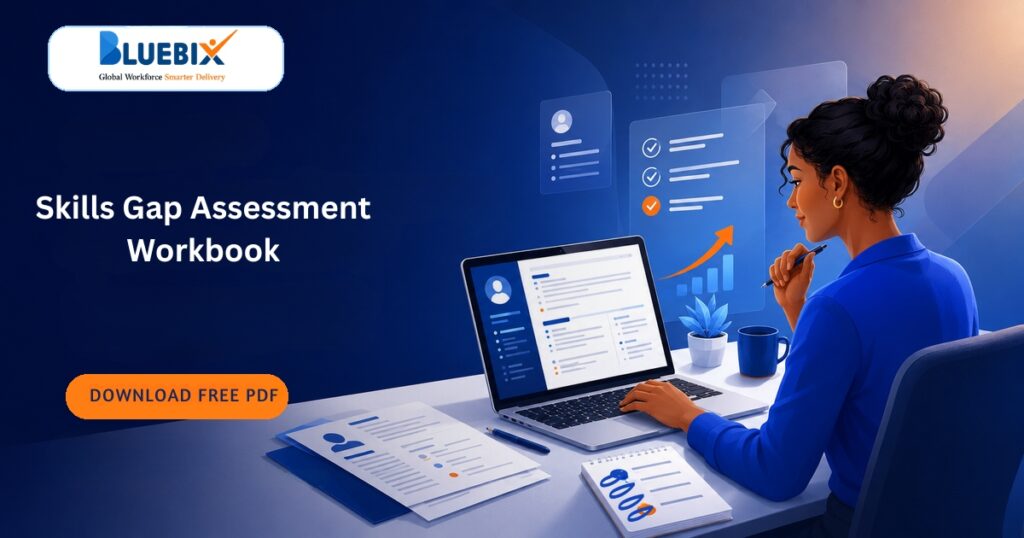
The BluebixInc 2026 Skills Gap Assessment Workbook is a practical career-development resource created for students, recent graduates, job seekers, career changers, and professionals who want a more structured approach to building career readiness.
The workbook helps you move from a general career goal to a focused development plan based on real job requirements and evidence of your current abilities.
Start by Defining Your Target Career
An effective skills-gap assessment begins with a specific destination.
Instead of saying, “I want to work in technology,” define the actual role you are targeting, such as Data Analyst, Software Developer, Project Engineer, Marketing Specialist, Financial Analyst, or another position that matches your interests.
The workbook encourages you to identify your target:
- Job title
- Industry
- Company type
- Location
- Experience level
- Career timeline
You will also reflect on why the career interests you and what you want to achieve within the next several months.
The clearer your target is, the easier it becomes to determine which skills actually matter.
Research the Skills Employers Really Require
Once you have selected a target role, the next step is understanding employer expectations.
Rather than building your development plan from a single job advertisement, review multiple relevant job postings. The workbook recommends comparing approximately 5–10 positions and identifying requirements that appear repeatedly.
Look for recurring:
- Technical skills
- Digital tools and software
- Industry knowledge
- Soft skills
- Certifications
- Education requirements
- Experience expectations
This approach helps you separate important market requirements from qualifications that may only apply to one employer.
Your goal is not to learn every keyword you see. Focus on recurring requirements that are relevant to the role you actually want.
Build an Honest Skills Inventory
After identifying target-role requirements, evaluate where you currently stand.
The workbook uses a practical five-level rating scale ranging from No Exposure to Advanced. For each important skill, record your current level, when you last used it, what evidence you can provide, and how confident you are.
Be realistic.
Knowing about a skill is different from being able to use it independently. Ask yourself:
Can I use this skill without help? Have I used it recently? Can I show evidence that I can perform it?
An honest assessment gives you a stronger starting point than an inflated list of skills.
Turn Skills Into Evidence
Employers do not only want to know what you claim to understand. Stronger candidates can demonstrate what they have done.
Career evidence can come from academic projects, personal projects, internships, employment, freelance assignments, volunteering, certifications, portfolios, case studies, competitions, research, or practical assignments.
This is especially important for students and recent graduates.
Experience is bigger than full-time job history. Coursework, university projects, volunteering, competitions, student organizations, and personal projects can all demonstrate useful capabilities when presented truthfully.
Think in terms of:
Skill → Practice → Project → Evidence → Career Story
Calculate and Prioritize Your Skills Gaps
Not every skill gap deserves the same amount of attention.
The workbook helps you compare your target skill level with your current skill level and identify where development is required.
You can then prioritize skills according to factors such as career relevance, frequency in job postings, current gap size, and urgency.
A critical skill that appears repeatedly in your target jobs should usually receive more attention than an optional tool mentioned by only one employer.
This prevents one of the most common career-development mistakes: trying to learn everything at once.
Build a 30/60/90-Day Career Development Plan
Once you know your priority gaps, turn them into action.
The workbook divides development into three practical stages:
Days 1–30: Foundation
Learn concepts, complete introductory lessons, and practice basic tasks.
Days 31–60: Practice
Complete realistic exercises, projects, simulations, case studies, or practical assignments.
Days 61–90: Proof
Build portfolio evidence, complete relevant certifications where appropriate, update your resume and LinkedIn profile, and prepare examples you can discuss during interviews.
The objective is not simply to finish courses. It is to build evidence that shows you can apply what you learned.
Download the 2026 Skills Gap Assessment Workbook
Career development becomes easier when you know where you are, where you want to go, and what needs to happen between those two points.
Download the free BluebixInc 2026 Skills Gap Assessment Workbook to create your Skills Gap Scorecard, identify priority skills, build a 30/60/90-day learning plan, develop career evidence, and create a focused Career Development Roadmap.
Identify your skills. Discover your gaps. Build your career plan.
About the Author
BluebixInc Editorial Team
Staffing insights and workforce solutions for employers.