Manufacturing Hiring Checklist: 12 Steps for HR Teams
Manufacturing hiring is more than filling an open position. Every production operator, maintenance technician, quality professional, warehouse worker, engineer, and supervisor affects safety, output, quality, delivery, and team performance.
When a critical role remains open, businesses may resort to overtime, delay orders, increase pressure on current employees, or compromise their growth plans.
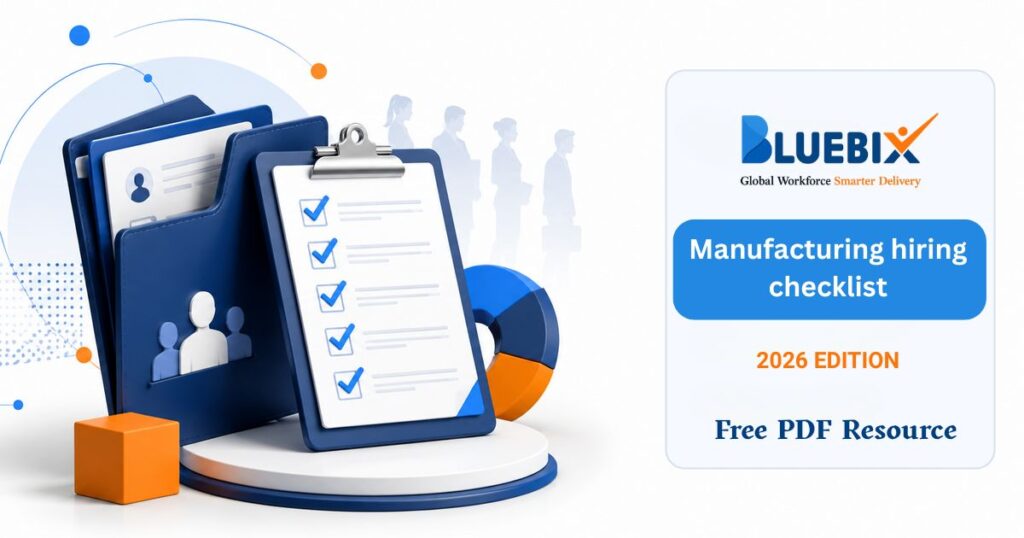
That is why Bluebix Inc. created the Manufacturing Hiring Checklist 2026 for HR teams, plant managers, business owners, and other hiring decision-makers.
It turns manufacturing recruitment into a repeatable operating process: plan the need, define the role, attract qualified talent, assess fairly, make the offer, prepare the new hire, and measure what happens after the start date.
Why Manufacturing Hiring Needs a Structured Process
Manufacturing roles often require a combination of technical ability, safety judgment, quality discipline, reliability, teamwork, and learning agility.
A resume may show where someone worked, but it does not always show how they respond to a production problem, report a hazard, handle a quality issue, or learn a new machine.
The labor market also includes a wide range of production and technical roles. The U.S. Bureau of Labor Statistics reported more than 12.8 million manufacturing workers in 2024 and projects nearly 550,000 annual openings in production occupations across all industries.
That makes a consistent, job-related hiring process valuable for organizations competing for dependable talent.
A strong checklist helps HR and operations work from the same evidence. It also reduces rushed decisions based only on urgency, personal impressions, or an unclear definition of “culture fit.”
What the Bluebixinc Manufacturing Hiring Checklist Covers
The PDF is designed as a working document, not just a list of generic hiring tips. It includes decision gates, scorecards, interview questions, assessment rubrics, onboarding records, a 30-60-90-day ramp plan, and a master worksheet for the full hiring team.
1. Plan the Workforce Need
Begin with the operating problem. Document whether the opening is caused by growth, replacement hiring, a new shift, seasonal demand, absenteeism, or a project. Define the number of hires, target start date, location, budget, coverage risk, and expected time to productivity.
This step helps leaders decide whether they need a permanent employee, temporary coverage, contract talent, temp-to-hire support, or a larger workforce solution.
2. Build a Role Scorecard
Create a job profile that reflects the real work. Separate skills required on day one from skills that can be taught through a structured ramp. The checklist recommends evaluating technical capability, quality and documentation, safety behaviors, reliability, teamwork, learning agility, and problem-solving ability.
For each requirement, define how success will be observed. For example, “quality awareness” is vague; “identifies a defect, documents it correctly, and escalates it before the next production step” is measurable.
3. Make the Job Posting Clear and Realistic
Candidates need to understand the actual schedule, location, environment, pay range, overtime expectations, equipment, training, benefits, and application process. Explain conditions such as standing, noise, temperature, PPE, cleanroom requirements, warehouse exposure, or outdoor work when they are part of the role.
A realistic job preview improves trust and can reduce early turnover caused by surprises. It also helps attract candidates who are genuinely comfortable with the work.
4. Build a Qualified Sourcing Pipeline
Use more than one channel. Employee referrals, technical schools, community colleges, apprenticeship programs, veteran transition programs, workforce boards, specialist job boards, hiring events, social campaigns, and staffing partners can each reach different talent pools.
Registered Apprenticeship can also help employers recruit, train, and retain manufacturing talent through paid work experience, mentorship, classroom instruction, and progressive skill development.
Track qualified candidates and hires by source—not only the number of applications. The best channel is the one that produces safe, capable, reliable employees.
5. Screen Consistently and Fairly
Use the same core screening criteria for comparable roles. Confirm interest in the actual shift and location, relevant hands-on experience, compensation alignment, start-date availability, and the candidate’s approach to quality and safety.
Keep questions job-related. If a candidate requests an accommodation, route the request through the established HR process. Employers should also be careful with medical and disability-related questions during pre-employment screening.
6. Verify Technical Ability With Job-Related Evidence
For many manufacturing jobs, a safe work sample or realistic job preview can reveal more than a resume.
Depending on the role, an assessment might involve blueprint reading, measurement, quality inspection, equipment simulation, a troubleshooting scenario, a digital manufacturing execution system task, or a safety judgment scenario.
Design the assessment before meeting candidates. Use the same instructions, scoring criteria, safety rules, trained raters, and accommodation pathway for everyone.
7. Use a Structured Interview
Ask each candidate the same core questions and score the evidence they provide. Strong questions include:
- Tell us about a time you caught a quality issue before it moved to the next step.
- Describe a situation where a production target conflicted with a safety concern.
- How do you troubleshoot a machine, process, or material problem?
- Tell us about a time you learned a new process or piece of equipment.
- What makes a shift handoff effective when the line is busy?
Evaluate what the candidate actually did, not simply how comfortable the conversation felt. Document the job-related reason for the decision and identify any skill gap that can be trained.
8. Protect Safety, Quality, and Fair Hiring
Before the first shift, identify role-specific hazards, PPE, required certifications, emergency procedures, hazard communication, and training ownership. OSHA states that workers must receive appropriate safety training before engaging in potentially hazardous activities.
Safety should never be traded for hiring speed. A fast hire who is not prepared for the work can create greater operational risk than a carefully managed ramp.
9. Make the Offer Realistic
Confirm the role, supervisor, worksite, shift, pay, differential, benefits, overtime, employment model, start date, and offer contingencies.
Explain what the first 30 days will involve. Candidates are more likely to accept—and remain in—a role when the written offer matches the job they were shown during recruitment.
10. Preboard and Onboard for the First 30 Days
Send first-day instructions, prepare access and PPE, assign a trainer or buddy, and build a training sequence covering safety, quality, standard work, equipment, systems, and sign-offs. The checklist includes a practical first-day, first-week, second-week, third-week, and day-30 schedule.
11. Use a 30-60-90-Day Ramp Plan
Set measurable expectations for safe work, quality, attendance, learning, handoffs, and increasing independence. Schedule short check-ins rather than waiting for a formal review. Ask what is working, what is harder than expected, what support is needed, and which skill the employee wants to learn next.
12. Measure and Improve the Hiring System
Review time to fill, time to start, source conversion, training completion, time to productivity, 30- and 90-day retention, quality trends, safety observations, and manager satisfaction.
Then conduct a hiring retrospective: Where did qualified candidates leave? Which requirements predicted success? What should change in the next requisition?
Download the Manufacturing Hiring Checklist
The Bluebix Inc. Manufacturing Hiring Checklist gives your team one source of truth for planning, screening, interviewing, offering, onboarding, retention, and hiring improvement. Use it during a single requisition, a high-volume hiring sprint, or a plant expansion.
Need qualified manufacturing talent? Explore Bluebix manufacturing staffing solutions for temporary staffing, contract staffing, direct hire recruitment, and workforce solutions supporting production, quality, plant operations, engineering, supply chain, and related roles.
Ready to build a stronger manufacturing workforce? Download the checklist or book a free consultation with Bluebix Inc.
About the Author
BluebixInc Editorial Team
Staffing insights and workforce solutions for employers.