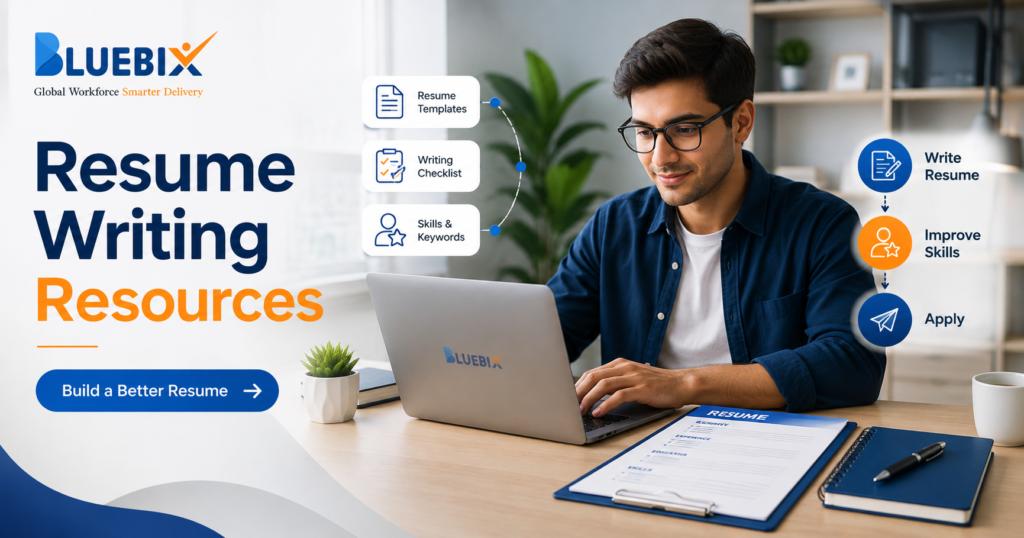
Writing a resume should be simple. Yet job seekers now face hundreds of templates, AI resume builders, ATS advice, keyword tools, and conflicting opinions about what employers actually want. The right resume writing resources can make the process much clearer.
A useful resource should do more than make your resume look attractive. It should help you explain your skills, achievements, experience, and value in a way that employers can quickly understand.
This guide brings together trusted resume guidance, practical templates, ATS tips, AI advice, examples, and step-by-step methods to help you create a stronger resume for your next opportunity.
1. What Are Resume Writing Resources, and Which Ones Do You Actually Need?
Resume writing resources are tools and educational materials that help you plan, write, format, review, or improve a resume.
They can include:
- Resume writing guides
- Professional resume templates
- Resume examples
- Action-verb lists
- ATS formatting guides
- Resume checklists
- Job-description analysis tools
- AI resume assistants
- Resume builders
- Career-center resources
- Professional resume reviews
Different resources solve different problems.
If you have never written a resume, a university or government guide may be the best place to start. If your content is strong but your layout is weak, a template may help. If you struggle to turn duties into achievements, resume examples and accomplishment-writing frameworks may be more useful.
Free vs. Paid Resume Resources
You do not automatically need a paid service to produce a professional resume. CareerOneStop, Harvard, USAJOBS, Indeed, and other organizations provide substantial free guidance.
Don’t Assume Paid Automatically Means Better
Evaluate any resource using five questions:
Is it accurate? Is it relevant? Is it easy to use? Can I customize the output? Can I trust the guidance?
The best tool is the one that helps you tell your real career story more clearly.
2. What Makes a Strong Resume in 2026?
A strong resume answers one important employer question:
“Why should we interview this person for this job?”
That means your resume needs more than a professional design.
It should show:
- Relevant experience
- Job-related skills
- Achievements
- Evidence of impact
- Clear career direction
- Easy-to-scan information
- Relevant education or credentials
Harvard describes a resume as a concise summary of your abilities, education, and experience, and recommends tailoring it to the type of position you want. It also recommends specific rather than general language and emphasizes your strongest assets.
Write for Both Humans and Applicant Tracking Systems
Think of your resume as a bridge with two lanes.
One lane serves technology. An applicant tracking system needs recognizable headings, readable text, relevant terms, and a format it can process.
The other lane serves humans. Recruiters and hiring managers need clear evidence that you can perform the job.
Your Resume Is Not Your Complete Career History
Do not treat your resume like an autobiography.
Use this Resume Relevance Test for every important line:
- Does this support my target job?
- Does it demonstrate a useful skill?
- Does it provide evidence?
- Does it help an employer understand my value?
If a detail does none of those things, shorten it or remove it.
3. Quick Comparison of the Best Resume Writing Resources
There is no single “best” resume website for everyone. The right choice depends on what you need help with.
| Resume Resource | Best For | Main Use | Cost Model |
| Harvard Mignone Center | Students and graduates | Guidance and templates | Free |
| CareerOneStop | U.S. job seekers | Formats, examples, ATS guidance | Free |
| USAJOBS | Federal job seekers | Federal resume requirements | Free |
| Indeed Career Guide | Beginners | Step-by-step resume education | Free |
| Resume.io | Template-focused users | Builder, examples, AI tools | Free/Paid |
| BluebixInc Resume Writing Guide | Job seekers and career changers | Resume planning, tailoring, and achievements | Free resource |
| AI assistants | Draft improvement | Brainstorming and editing | Varies |
CareerOneStop offers sample resumes and detailed guidance on chronological, combination, and functional formats. Resume.io currently provides hundreds of industry-specific examples, templates, and AI-assisted building tools.
BluebixInc also provides an 18-page 2026 Resume Writing Guide covering resume structure, keywords, measurable achievements, tailoring, career changes, and final checklists.
Which Resource Should You Start With?
Use government or university guidance to learn, templates to format, examples to improve writing, AI to assist with editing, and a human review or checklist before submitting.
4. How to Choose the Right Resume Format and Template
Before choosing colors or fonts, choose the right resume structure.
Reverse-Chronological Resume
A reverse-chronological resume presents your newest job first and lists them in reverse order.
It usually works best for people with:
- A consistent employment history
- Clear career progression
- Relevant recent experience
- Experience in the same or a related field
CareerOneStop recommends the chronological format for candidates with a solid work history who plan to stay in the same field.
Combination Resume
A combination or hybrid resume balances skills with detailed employment history.
It can work well for:
- Career changers
- Professionals with transferable skills
- Candidates returning to a field
- People repositioning varied experiences
CareerOneStop notes that this format can highlight transferable skills while still providing the detailed work history employers expect.
Functional Resume
A functional resume focuses mainly on skills rather than chronological work history.
Use it carefully. CareerOneStop warns that a lack of detailed work history may be misunderstood by employers and create problems for applicant tracking systems.
What Makes a Resume Template ATS-Friendly?
Look for:
- One-column structure
- Standard headings
- Readable fonts
- Consistent dates
- Normal bullet points
- Clear spacing
- Limited visual decoration
Resume Design Elements to Use Carefully
CareerOneStop advises caution with tables, text boxes, logos, multiple columns, images, and graphics because ATS software may scramble the information they contain.
PDF or Word?
Follow the employer’s instructions first.
PDF usually preserves formatting well, while some employers specifically request DOC or DOCX. USAJOBS currently recommends PDF for maintaining formatting while accepting several other formats.
5. How to Write a Resume Step by Step
A template gives you the container. Your content gives employers a reason to interview you.
Start With Your Contact Information
Keep the top of your resume simple.
Usually include:
- Full name
- Professional email
- Phone number
- City and state
- LinkedIn profile, when relevant
- Portfolio or professional website, when relevant
Indeed’s current resume-writing guidance recommends basic contact information and relevant professional or portfolio links.
What You Usually Don’t Need
For a typical U.S. private-sector resume, avoid unnecessary personal details such as your Social Security number, age, marital status, or photograph unless there is a legitimate job-specific reason.
USAJOBS similarly tells federal applicants not to include a Social Security number, photograph, age, sex, religious affiliation, or similar personal information.
Write a Clear Resume Headline
A headline can quickly tell the reader what kind of professional you are.
Weak:
Marketing Professional
Stronger:
B2B Digital Marketing Specialist | SEO, PPC & Lead Generation
For an operations candidate:
Manufacturing Operations Manager | Lean Operations | Production Leadership
For HR:
Talent Acquisition Manager | Workforce Planning | Technical Recruiting
The goal is not to sound impressive. The goal is to provide context quickly.
Write a Professional Summary That Shows Value
A summary should connect your experience to your target position.
Avoid generic statements such as:
“Hardworking professional seeking an opportunity at a growing company.”
Instead, answer:
- Who are you?
- What do you specialize in?
- What evidence supports your strengths?
- What kind of value can you bring?
Simple Resume Summary Formula
Use:
Professional identity + experience + specialization + evidence + target value
Example:
“Manufacturing operations leader with eight years of experience managing production teams, process improvement, quality control, and scheduling across high-volume facilities. Experienced in Lean practices, workforce coordination, and reducing production delays.”
Turn Job Responsibilities Into Achievements
This is where many resumes become weak.
A job description explains what someone in the role is supposed to do. Your resume should explain what you actually did and what happened as a result.
Weak:
Responsible for customer accounts.
Stronger:
Managed 45+ B2B customer accounts while maintaining a 94% annual retention rate.
CareerOneStop recommends describing the context and outcome of your work and adding numbers, percentages, dollar amounts, or other evidence when appropriate.
Achievement Bullet Formula
Try:
Action + task + context + result
For example:
Coordinated weekly production schedules across three departments, helping reduce recurring scheduling conflicts during peak periods.
Another useful framework is:
Accomplished X, measured by Y, by doing Z.
USAJOBS currently uses this framework in its federal resume guidance.
What If You Don’t Have Numbers?
Never invent them.
You can still show:
- Volume
- Scope
- Frequency
- Complexity
- Speed
- Responsibility
- Recognition
- Improvement
- Adoption
Instead of writing:
Helped with employee training.
Try:
Trained new team members on order-processing procedures and daily quality checks.
Specific evidence is better than a fake percentage.
Build a Relevant Skills Section
Prioritize technical and job-specific skills.
Examples may include:
- Excel
- Salesforce
- AutoCAD
- SAP
- Python
- CNC equipment
- Google Analytics
- Project scheduling
- Quality systems
- Relevant certifications
CareerOneStop recommends including skills relevant to the target job and gives particular emphasis to technical and job-specific skills.
Avoid the Skill Dump
Do not list 30 abilities simply because they appeared in the job description.
Every important skill should pass one test:
Could you explain where and how you used it during an interview?
If not, leave it out.
Add Education, Certifications, Projects, and Optional Sections
Depending on your career stage, additional sections may strengthen your resume.
Consider:
- Education
- Certifications
- Professional licenses
- Academic projects
- Volunteer work
- Awards
- Professional associations
- Publications
- Languages
- Portfolio projects
CareerOneStop recommends using optional sections when they are relevant to the job goal rather than adding them merely to fill space.
Relevance should always control what stays.
6. How to Make Your Resume ATS-Friendly Without Keyword Stuffing
An applicant tracking system, or ATS, is software employers use to collect, organize, search, and manage applications.
That does not mean every ATS works the same way.
Avoid internet claims such as:
“Every resume needs an ATS score above 80%.”
There is no universal score that applies to every employer, platform, or hiring workflow.
Indeed’s 2026 guidance explains that ATS platforms may scan resumes for information such as job titles, skills, certifications, and relevant keywords.
Use Job Description Keywords Naturally
Read the job posting and identify:
- Job title
- Required skills
- Software
- Certifications
- Tools
- Industry terminology
- Key responsibilities
- Required experience
Then connect those requirements to real evidence.
Build a Job Description Keyword Map
| Employer Requirement | Your Evidence | Resume Location |
| Excel | Built a weekly reporting dashboard | Experience |
| Project management | Coordinated 12 client projects | Experience |
| Salesforce | Used CRM for three years | Skills + Experience |
| Team leadership | Supervised eight employees | Experience |
This approach is better than blindly copying keywords because every important term is supported by proof.
Don’t Copy the Job Description
Tailoring means using the employer’s language to accurately describe your experience.
It does not mean copying whole paragraphs from the job advertisement.
A recent recruiter discussion on Reddit recommends identifying several genuine must-have requirements and ensuring each important skill has supporting evidence, rather than stuffing the resume with repeated keywords. This is practitioner experience rather than formal research, but it aligns with stronger evidence-based tailoring practices.
Keep Formatting Easy to Parse
CareerOneStop recommends:
- Simple single-column layouts
- Standard section headings
- Consistent dates
- Professional fonts
- Clear bullet points
It advises avoiding unnecessary tables, graphics, text boxes, images, and multiple columns, as ATS tools may interpret them incorrectly.
Never Use Invisible Keyword Stuffing
Do not paste hidden keywords into white text.
CareerOneStop specifically warns that adding white-font keywords will not “trick” an ATS.
Optimize for clarity, not loopholes.
7. How to Use AI for Resume Writing Without Losing Your Voice
AI can be one of the most useful modern resume-writing resources when you provide accurate information and review its output carefully.
What AI Is Good At
Use AI to:
- Brainstorm stronger bullet structures
- Shorten long sentences
- Improve clarity
- Suggest action verbs
- Analyze a job description
- Identify possible relevant keywords
- Compare job requirements with your existing resume
- Proofread
- Generate questions that help uncover achievements
Harvard recommends starting with your own resume and using generative AI as an editing tool. It says AI can help revise bullets and incorporate relevant job-description keywords, but should not become the primary author because the result may become generic.
What AI Should Never Invent
Do not let an AI tool manufacture:
- Skills
- Metrics
- Certifications
- Degrees
- Promotions
- Software knowledge
- Responsibilities
- Projects
- Clients
- Results
A useful prompt might say:
“Improve these resume bullets for a production-management position. Use only the information I provide. Do not invent metrics, skills, tools, or achievements. Ask me questions when evidence is missing.”
Human Verification Checklist
After using AI, ask:
Did I actually do this?
Is every number accurate?
Could I confidently explain this sentence in an interview?
Current job-seeker discussions show ongoing concern that AI-written resumes sound generic or contain unsupported claims. Reddit is anecdotal evidence, but the concern is useful: AI should polish your evidence, not create a fictional career.
8. Best Resume Writing Resources by Career Situation
The best resume advice changes depending on where you are in your career.
Students and Recent Graduates
Prioritize:
- Education
- Internships
- Academic projects
- Volunteer work
- Student organizations
- Coursework
- Transferable skills
Harvard’s resume resources are especially useful for students and graduate audiences.
Job Seekers With No Experience
“No professional experience” does not mean “no evidence.”
Look at:
- Projects
- Part-time jobs
- Volunteering
- Certifications
- Student leadership
- Freelance work
- Relevant coursework
The goal is to demonstrate capabilities through the experience you do have.
Career Changers
Focus on transferable skills and achievements that connect your old work to the new target.
A combination format may help by allowing you to foreground relevant skills while preserving an understandable employment history.
Experienced Professionals
Prioritize recent and relevant:
- Business outcomes
- Leadership
- Promotions
- Major projects
- Process improvements
- Scope and scale
CareerOneStop suggests emphasizing the most valuable and relevant jobs for people with longer career histories.
Managers and Executives
Company owners, general managers, production leaders, HR managers, business development executives, and heads of talent should show leadership with evidence.
Include relevant:
Team size + budget/revenue scope + transformation + operational impact + growth + cost reduction + strategic responsibility
Federal Job Seekers
Use federal-specific guidance rather than assuming a private-sector resume will work unchanged.
As of 2026, USAJOBS states that resumes submitted through its system must be two pages or less and should directly demonstrate how the applicant meets the announcement’s requirements.
9. Common Resume Writing Mistakes—and How to Fix Them
Even a strong candidate can become difficult to evaluate when the resume hides the evidence.
Using One Resume for Every Job
Fix: tailor the most relevant sections to important applications.
Listing Responsibilities Without Results
Fix: explain what you did, how you did it, and what changed.
Keyword Stuffing
Fix: Use important job terminology only where it truthfully matches your skills and experience.
Using Generic AI Language
Be careful with phrases such as:
- Results-driven professional
- Dynamic thought leader
- Strategic visionary
- Spearheaded transformative initiatives
Specific evidence usually sounds stronger than exaggerated language.
Overdesigning the Resume
Fix: prioritize readability and structure over decoration.
Writing Too Much
Fix: remove repeated, outdated, and low-value information.
Formatting Inconsistently
Review:
- Fonts
- Dates
- Bullets
- Spacing
- Headings
- Capitalization
Failing to Proofread
Indeed recommends carefully checking resumes for spelling and grammar errors and keeping content clear and concise.
Harvard similarly emphasizes clarity, active language, specificity, and evidence of results.
A polished resume is easier to trust.
10. Final Resume Checklist: Review Your Resume Before Applying
Before submitting an application, perform one final quality check.
Content Checklist
- The target role is clear
- Contact information is correct
- Summary supports the target job
- Important keywords appear naturally
- Achievements have evidence
- Skills are accurate
- Dates are consistent
- Numbers are truthful
- No AI-generated claims were added without verification
Formatting Checklist
- The layout is easy to scan
- Fonts are consistent
- Headings are recognizable
- Bullets are readable
- Graphics are limited
- File format follows employer instructions
- Document opens correctly
The 30-Minute Resume Tailoring Workflow
Minutes 1–5: Read the job description.
Minutes 5–10: Identify the most important requirements.
Minutes 10–20: Adjust your summary, skills, and strongest experience bullets.
Minutes 20–25: Check keywords and ATS-friendly formatting.
Minutes 25–30: Proofread and verify every claim.
Final Question
Ask yourself:
“If an employer scanned this resume quickly, would they understand why I could succeed in this specific job?”
If the answer is unclear, revise before applying.
11. FAQ: Resume Writing Resources
What are the best free resume writing resources?
Strong free resources include CareerOneStop for resume formats and ATS guidance, Harvard’s career resources for writing and templates, USAJOBS for federal applications, Indeed’s Career Guide for step-by-step instruction, and BluebixInc’s Resume Writing Guide 2026 for practical planning, achievement writing, keyword mapping, tailoring, and job-seeker checklists.
What is the best resource for learning how to write a resume from scratch?
Beginners benefit most from structured resources that explain each section rather than simply providing a blank template. Indeed offers a straightforward writing process, while CareerOneStop covers formatting, experience, skills, and samples. BluebixInc’s guide adds practical worksheets and evidence-based bullet-writing exercises. Start by learning the structure, then choose a template.
Which resume format is best for ATS systems?
A clean chronological or combination resume with a simple single-column layout is usually a safer starting point. CareerOneStop specifically recommends single-column formatting and standard section headings and warns that tables, text boxes, images, graphics, and multiple columns can disrupt ATS reading. Always follow the employer’s instructions when they differ.
Should I use a resume template or build my resume from scratch?
Templates can save time and improve consistency, but the template should support your information rather than control it. Start with your career evidence, choose a simple structure, and then apply a suitable template. Avoid choosing a design merely because it looks impressive. Recruiters need to find relevant qualifications quickly.
Can ChatGPT or another AI tool write my resume?
AI can help improve an existing resume, but letting it invent the entire document poses risks to accuracy and authenticity. Harvard recommends using generative AI for editing, brainstorming, incorporating keywords, and revising rather than making it the primary author. Give AI real information, review every sentence, and never accept invented achievements.
Should I tailor my resume for every job application?
Tailoring is most valuable when a position genuinely matters to you, and your qualifications match the role. You do not need to rebuild the entire resume. Update the summary, important skills, and strongest bullets so that relevant experience becomes easier to see. Indeed and USAJOBS both recommend matching relevant experience to job requirements.
How do I write a resume when I have no professional work experience?
Use other forms of evidence. Include internships, academic projects, volunteer work, student organizations, certifications, coursework, freelance projects, competitions, part-time jobs, and personal projects when they demonstrate useful skills. Describe what you did and what you learned or achieved, rather than apologizing for not having a traditional career history.
How long should a resume be in 2026?
For many U.S. private-sector applicants, one or two pages remains a practical guideline. CareerOneStop recommends one to two pages, and using the second page when experience warrants it. Federal applicants should note that USAJOBS currently limits resumes submitted through its system to two pages.
What should I remove from an outdated resume?
Remove old information that no longer strengthens your target application. This may include outdated software, irrelevant early-career tasks, generic objectives, repeated responsibilities, obsolete contact information, and details that consume space without showing useful qualifications. Keep older experience when it provides important evidence, leadership history, specialized expertise, or career context.
How can I tell whether my resume is actually ATS-friendly?
Check whether it uses standard headings, readable text, a simple structure, consistent dates, normal bullet points, and relevant job terminology. Avoid hidden text and unnecessary design elements. Then save the document in the employer’s requested format. Most importantly, make sure the resume remains clear when copied as plain text.
12. Conclusion: Use Resume Resources to Tell a Stronger Career Story
The best resume writing resources cannot replace your experience. They help you present that experience more clearly.
A useful process is simple:
Research → Select → Write → Prove → Tailor → Review.
Choose reliable guidance, use an ATS-friendly format, show achievements instead of only responsibilities, tailor important applications, and use AI as an assistant rather than a source of invented experience.
If you want a practical next step, BluebixInc’s free Resume Writing Guide 2026 provides resume-planning worksheets, writing frameworks, keyword guidance, achievement examples, and a final checklist. From there, you can explore BluebixInc career resources and opportunities that match your skills and career goals.
About the Author
BluebixInc Editorial Team
Staffing insights and workforce solutions for employers.