Best Tips for Job Searching: Resume, Interview & Career Advice

Searching for a job can feel like throwing resumes into a dark room and hoping someone notices. But successful job searching is rarely about sending the most applications. The best tips for job searching focus on choosing the right roles, providing clear evidence of your skills, finding opportunities across multiple channels, and refining your approach as you learn.
There are still millions of opportunities in the U.S. labor market. The Bureau of Labor Statistics reported about 7.3 million job openings in July 2026, while hires were about 5.1 million.
This guide gives students and job seekers a practical system for turning that opportunity into interviews and, ultimately, finding the right job.
What Does an Effective Job Search Look Like?
Job Searching Is More Than Sending Applications
A good job search works like a funnel:
Target → Research → Prepare → Find → Apply → Network → Interview → Follow Up → Evaluate
Skipping the first stages usually creates problems later. If you do not know which roles you want, your resume becomes too general. If you do not research employers, your applications sound generic. If you never track results, you cannot tell what needs improvement.
CareerOneStop, a U.S. Department of Labor-sponsored resource, similarly organizes job searching around planning, employer research, networking, job discovery, resumes, interviews, recruiters, and salary negotiation.
Quality Applications vs. Mass Applications
Sending 100 applications does not automatically improve your search.
A stronger goal is to submit applications where you can clearly explain:
- Why you fit the role
- Which skills do you have
- What evidence supports those skills
- Why are the organization’s interests in you
- What value could you contribute
Recent Reddit discussions show the same frustration: candidates describe application overload and debate how much time to spend tailoring each resume. Those conversations are anecdotal, not scientific evidence, but they highlight a real practical problem—job seekers need efficiency as well as quality.
Tip #1 — Define the Job You Actually Want Before You Start Searching
One of the most overlooked job search strategies is deciding what you are actually looking for.
Do not begin with:
I need any job.
Identify Your Target Job Titles
Choose two or three primary job titles. Then identify related titles employers might use.
For example, someone interested in data may search for:
- Junior Data Analyst
- Business Data Analyst
- Reporting Analyst
- Data Operations Associate
- Business Intelligence Intern
Also, decide your preferred industry, location, schedule, employment type, and remote or onsite preference.
Match Your Skills With Real Job Requirements
Open 10–15 current job descriptions for your target role. Write down the requirements that appear repeatedly.
Then build this simple skills-gap table:
Employer Needs → Skills I Have → Skills I Need → Evidence I Can Show
Evidence matters. Saying “I know Excel” is weaker than explaining that you used Excel to clean data, create pivot tables, track inventory, or analyze a class project.
BluebixInc’s Skills Gap Assessment Workbook can support this process by helping job seekers identify target roles, existing skills, gaps, and development priorities.
Research Salary, Demand, and Career Outlook
Before committing to a career path, check:
- Typical pay
- Required education
- Experience requirements
- Training
- Geographic demand
- Employment outlook
The BLS Occupational Outlook Handbook provides this information for hundreds of U.S. occupations.
Tips #2–4 — Build a Resume and Online Profile Employers Can Understand Quickly
Your resume should answer one basic employer question:
Why should I continue reading?
Tip #2 — Create a Strong Master Resume
Start with one master document containing your full career information:
- Work experience
- Internships
- Education
- Projects
- Certifications
- Technical skills
- Volunteer work
- Achievements
- Relevant coursework
You will not send the complete master resume every time. Think of it as your toolbox. For each application, you select the tools that fit the job.
Case Western Reserve University’s career center describes a resume as a living document rather than something permanently “finished.”
Tip #3 — Tailor Your Resume for Important Applications
Tailoring does not mean rewriting your career history or copying the employer’s job description.
It means moving your most relevant evidence closer to the top.
Match Job Description Keywords Naturally
Look for repeated:
- Skills
- Software
- Certifications
- Tools
- Responsibilities
- Industry terms
If the posting asks for “inventory management” and you genuinely have that experience, use the same clear terminology.
Do not stuff keywords you cannot explain during an interview.
Show Evidence Instead of Generic Claims
Use this simple resume formula:
Action + Task + Method + Result
Weak:
“Responsible for customer service.”
Stronger:
Use numbers only when they are truthful.
BluebixInc’s 2026 Resume Writing Guide recommends keeping a master resume, creating keyword maps, selecting strong proof points, and tailoring key applications without copying job descriptions.
Tip #4 — Optimize Your LinkedIn Profile
Your LinkedIn profile should align with the professional direction of your resume.
Review your:
- Headline
- About section
- Experience
- Education
- Skills
- Projects
- Certifications
- Location
- Job preferences
Instead of a vague headline such as “Student Looking for Opportunities,” try:
Business Analytics Student | Excel, SQL & Data Visualization | Seeking Analyst Internship
BluebixInc’s LinkedIn Profile Optimization Guide 2026 similarly recommends aligning your headline, skills, projects, career evidence, and job preferences around a single clear direction.
Tip #5 — Where to Search for Jobs: Compare the Best Job Search Channels
Do not build your entire job search around one website.
Quick Comparison of Job Search Methods
| Job Search Channel | Best For | Main Advantage |
| Company career pages | Targeted applications | Direct access to current employer openings |
| Professional roles | Jobs, recruiters, and networking | |
| Job boards | Broad discovery | Large number of listings |
| Staffing agencies | Candidates seeking recruiter support | Additional employer opportunities |
| Networking and referrals | Relationship-based searches | Information and introductions |
| College career centers | Students and graduates | Internships and entry-level jobs |
CareerOneStop recommends using several of these channels, including online job banks, recruiters, networking, and local employment resources.
Company Career Pages
Build a list of 20–30 employers you would genuinely consider.
Check their career pages regularly instead of waiting for a job board to show you every vacancy.
LinkedIn and Job Boards
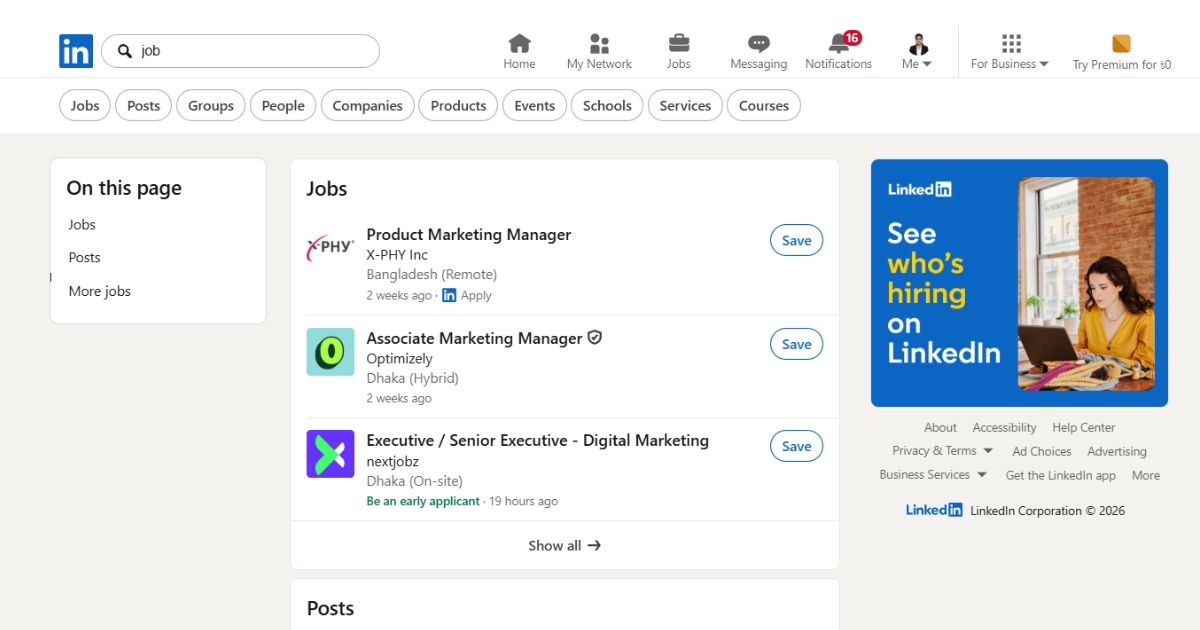
Use filters for:
- Job title
- Location
- Experience level
- Industry
- Employment type
- Date posted
Create alerts so you do not have to repeat the same search every morning.
Staffing and Recruitment Agencies
Staffing agencies can connect job seekers with employers looking for permanent, contract, temporary, or project-based talent.
A recruiter cannot guarantee you a job, but the relationship can become another useful channel for your search.
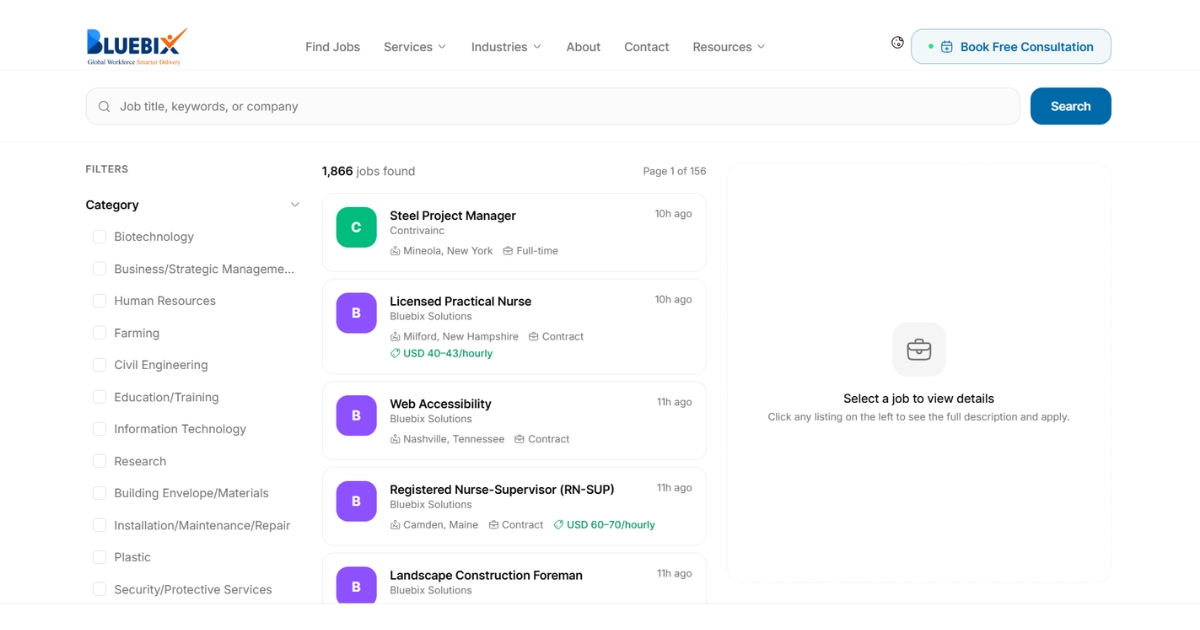
For example, job seekers can explore opportunities and career resources through BluebixInc, which provides staffing and workforce solutions across multiple U.S. industries.
Alumni, Career Centers, and Networking
Students should also use professors, alumni groups, school career centers, professional associations, career fairs, and former classmates.
The mistake is thinking a job board is the job market. It is only one door into it.
Tips #6–8 — Apply Strategically Instead of Applying Everywhere
Tip #6 — Evaluate the Job Before Applying
Before spending time on an application, place the opportunity into one of three categories:
Strong Match — Possible Match — Low Match
Compare yourself with:
- Required skills
- Preferred skills
- Experience
- Education
- Certifications
- Location
- Work arrangement
- Compensation
- Employment authorization
A “possible match” can still be worth pursuing.
Tip #7 — Understand Required vs. Preferred Qualifications
Students often make a costly mistake: they read one requirement they do not have and immediately close the job posting.
Look carefully at the wording.
“Required” and “must have” carry more weight than “preferred,” “desired,” or “nice to have.”
If you meet the central requirements and can perform the main work, consider applying even if you do not match every preferred item.
But do not hide genuine gaps.
Tip #8 — Track Important Applications
Job searching becomes confusing quickly. After 25 applications, you may forget which resume you sent, when you applied, or whether you promised to follow up.
What Should Be in Your Job Application Tracker?
Record:
- Company
- Job title
- Posting link
- Date applied
- Contact person
- Resume version
- Application status
- Follow-up date
- Interview date
- Salary information
- Notes
Then review your funnel weekly.
A useful BluebixInc Job Search Funnel Diagnostic is:
Applications → Employer Responses → Interviews → Final Interviews → Offers
If you have many applications but almost no responses, investigate targeting and resume relevance.
If you receive screening calls but rarely reach hiring managers, review how you explain your experience.
If you reach final interviews but receive no offers, analyze interview evidence, role fit, competition, references, and compensation alignment.
Do not diagnose every problem by simply applying more.
Tips #9–10 — Use Networking and LinkedIn to Find Opportunities Others Miss
Good networking means learning from people and building professional relationships.
Tip #9 — Build Relationships Before Asking for Help
Your network may include:
- Classmates
- Alumni
- Professors
- Former colleagues
- Supervisors
- Recruiters
- Industry professionals
- Professional associations
- Friends and relatives
Case Western Reserve University recommends networking and informational interviews as part of the job-search process. Its guidance also makes an important distinction: an informational interview is for learning about someone’s experience and career, not for directly asking that person for a job.
How Do I Network When I Don’t Know Anyone?
Start small.
Instead of:
Hi, do you have any jobs?
Try:
I’m a recent finance graduate exploring entry-level financial analyst roles. I saw that you work in corporate finance. If you have 15 minutes sometime, I’d appreciate hearing what skills helped you most early in your career.
Now the conversation has a purpose.
Tip #10 — Become Easier for Recruiters to Understand
Your LinkedIn profile should quickly communicate:
Who you are + what you know + evidence + what you want next
Use relevant job titles and skill terminology, but keep it natural.
Post or share meaningful professional material occasionally:
- Projects
- Certifications
- Portfolio work
- Industry observations
- Lessons from internships
- Professional learning
Networking works more like planting a garden than pressing a vending-machine button. Some conversations produce immediate opportunities. Others become useful months or years later.
Tips #11–12 — Use AI to Improve Your Job Search Without Losing Authenticity
AI can make job searching faster, but it should work as your assistant—not your fictional biographer.
Tip #11 — Use AI for Career and Job Research
Useful questions include:
“What entry-level jobs match these skills?”
“Compare my background with this job description.”
“Which skills appear most often in these five job postings?”
“What interview questions could this job description produce?”
You can also use tools such as ChatGPT, Gemini, Claude, Copilot or Perplexity to organize research and discover topics that require deeper checking.
Always verify important information against employer websites and trusted occupational sources.
Tip #12 — Improve Applications, but Never Invent Qualifications
AI can help with:
- Resume feedback
- Keyword extraction
- Job Description Analysis
- Cover-letter brainstorming
- Interview practice
- Career research
- Grammar and clarity
It should not invent:
- Jobs
- Certifications
- Degrees
- Skills
- Metrics
- Projects
- Responsibilities
A useful workflow is:
AI Draft → Human Edit → Fact-Check → Personalize → Submit
BluebixInc’s AI Job Search Guide 2026 follows the same principle: use AI to research, organize, prepare and practice while keeping real skills, experience and judgment at the center of the process.
Tips #13–15 — Turn More Interviews Into Job Offers
Getting an interview means your application has done its first job. Now you must make your evidence easier to understand.
Tip #13 — Research the Employer Before the Interview
Study:
- Products or services
- Customers
- Mission
- Industry
- Competitors
- Recent developments
- Job responsibilities
- Interviewer, when appropriate
Case Western Reserve University recommends reviewing the organization, position, and employer before interviewing rather than relying only on rehearsed answers.
Tip #14 — Build a Career Story Bank
Prepare several real situations that show how you work.
Prepare stories about:
- Solving a problem
- Working with a team
- Meeting a deadline
- Learning something quickly
- Handling conflict
- Making a mistake
- Improving a process
Students can use coursework, projects, internships, clubs, part-time jobs, sports, and volunteer activities.
You do not need ten years of work experience to have evidence.
Tip #15 — Ask Better Interview Questions
The questions you ask help you understand whether the job is right for you.
Try:
- “What would success look like during the first 90 days?”
- “What challenges should this person solve first?”
- “How will performance be measured?”
- “Why is the role currently open?”
- “What does the next stage of the interview process involve?”
BluebixInc Interview Preparation Guide also recommends researching before rehearsing, building specific proof points, and preparing career stories rather than memorizing scripts.
Tips #16–17 — Follow Up Professionally and Evaluate the Offer
Tip #16 — Follow Up Without Becoming Pushy
After Applying
If an employer provides a timeline, respect it.
If no timeline exists and you have a relevant contact, a short professional follow-up can confirm your continued interest.
Avoid sending repeated daily messages.
After an Interview
Send a brief thank-you message when appropriate.
Mention:
- Appreciation for the conversation
- One specific point discussed
- Your continued interest
- A short reminder of your relevant fit
Tip #17 — Evaluate More Than Salary
A job offer contains more than one number.
Compare:
- Base salary
- Bonus or incentives
- Health benefits
- Retirement benefits
- Paid leave
- Schedule
- Remote or on-site expectations
- Commute
- Responsibilities
- Manager
- Career growth
- Training
- Stability
- Employment type
Use salary data from credible sources before negotiating. BLS provides wage information by occupation and location that can help job seekers understand the market context.
If you negotiate, stay professional. Explain your request using evidence such as market data, relevant experience, responsibilities, and specialized skills rather than simply saying, I want more.
Common Job Search Mistakes That Can Keep You From Getting Hired
Watch for these common problems:
Applying to Everything
A scattered search produces scattered applications.
Using the Same Resume for Every Role
Your experience stays true, but the most relevant evidence should change with the opportunity.
Ignoring Networking
Job boards are useful, but they should not be your only source.
Using Generic AI-Generated Applications
Recruiters need to understand you, not a generic collection of polished phrases.
Applying Without Research
Know what the employer actually does before you invest your time.
Failing to Track Results
Without tracking, you cannot identify where your job-search funnel is failing.
Ignoring Job Scams
This matters more than ever.
In April 2026, the FTC warned about fake recruiters sending unexpected job offers via text and directing targets to fake remote jobs or schemes that require money. The FTC’s broader guidance is simple: legitimate employers should not require you to pay money to get paid or obtain a job.
University career centers also warn students to be cautious about requests for bank information, payments, unusual checks or sensitive personal information.
Job Searching Tips for Students and Candidates With No Experience
Stop Saying, “I Have No Experience”
You may have no full-time professional experience. That is not the same as having no evidence.
Your career evidence can come from:
Education + Projects + Internships + Volunteer Work + Part-Time Jobs + Certifications + Activities
Highlight Transferable Skills
Employers may care about skills you developed outside a traditional office.
Examples include:
- Communication
- Teamwork
- Organization
- Problem solving
- Customer service
- Leadership
- Research
- Data analysis
- Technical tools
- Time management
Case Western’s resume guidance specifically includes areas such as education, experience, skills, leadership, coursework and community service as possible resume content.
Build Evidence When Experience Is Missing
Create Projects
Build something you can discuss or show.
Complete Relevant Training
Choose learning that supports a real target role rather than collecting random certificates.
Seek Internships or Volunteer Experience
Experience does not have to begin with a perfect full-time job.
A marketing student can manage communications for a student club. A data student can build a portfolio analysis. An aspiring developer can publish a project.
Your goal is to turn “I know this skill” into “Here is evidence that I used it.”
A Simple 30-Day Job Search Plan
Week 1 — Define and Prepare
- Choose two or three target roles.
- Review real job descriptions.
- Complete a skills-gap analysis.
- Build your master resume.
- Update LinkedIn.
Week 2 — Research and Apply
- Create a target-employer list.
- Set job alerts.
- Find relevant recruiters or staffing agencies.
- Submit focused applications.
- Start tracking results.
Week 3 — Network and Prepare
- Reach out to alumni and industry contacts.
- Schedule informational conversations.
- Practice interview questions.
- Build five strong career stories.
Week 4 — Review and Improve
Look for the bottleneck.
Many applications + few responses? Review targeting and resume relevance.
Many first interviews + few second interviews? Improve your evidence and interview answers.
Final interviews + no offers? Review fit, positioning, references, compensation expectations and interview performance.
Treat your search like a system you can improve, not a judgment about your worth.
FAQ: Frequently Asked Questions About Job Searching
What are the best tips for job searching?
Start with a clear target role, build a relevant resume, use several job-search channels, network with people in your field, tailor important applications, prepare carefully for interviews, and track your results. The strongest job search is a repeatable system rather than a daily race to submit the most applications.
What is the most effective way to find a job?
There is no single best channel. Combine company career pages, job boards, LinkedIn, recruiters or staffing agencies, professional networking, referrals, and career centers. CareerOneStop also recommends a multi-channel approach that covers employer research, networking, job discovery, resume writing, and interviews.
How many jobs should I apply for each day?
There is no evidence-based universal number that works for every candidate. A software engineer, a warehouse associate, and a senior executive face very different markets. Set a sustainable weekly goal, but prioritize jobs where your skills genuinely match the requirements and where you have enough time to submit a strong application.
How can I find a job with no experience?
Use evidence from school projects, coursework, volunteer work, internships, part-time jobs, student organizations, certifications, and personal projects. Target entry-level positions where employers expect developing talent. Build examples demonstrating transferable skills such as communication, teamwork, problem-solving, technical ability, and learning speed.
Is LinkedIn good for finding jobs?
Yes, particularly when you use it for more than clicking “Apply.” Follow employers, create alerts, research hiring managers, connect with relevant professionals, display projects, and keep your skills current. Your profile should make your target direction clear so a recruiter can quickly understand what kind of opportunity fits you.
Should I use a staffing agency to find a job?
A staffing agency can be a useful additional channel, especially for contract, temporary, direct-hire, and specialized opportunities. You should still continue your own job search. Research any agency before providing personal information, and be suspicious of anyone demanding payment in exchange for a supposed job opportunity.
How can I use ChatGPT or other AI tools during my job search?
Use AI to analyze job descriptions, identify relevant skills, brainstorm resume improvements, research career paths, and practice interview questions. Always fact-check the output. Never allow an AI tool to invent skills, accomplishments, employers, certifications or experience. Your final application should accurately represent you.
Why am I applying for jobs but getting no interviews?
Review your search funnel. You may be targeting roles that do not match your experience, using a resume that does not clearly show relevant evidence, missing important requirements or relying too heavily on broad job-board applications. Compare 10 recent applications and look for repeated problems before submitting another 50.
How long should I wait before following up on a job application?
First, check the posting or confirmation email for instructions. If the employer provides a timeline, follow it. If not, a polite follow-up after a reasonable period may be appropriate once you have a legitimate contact. Avoid repeated messages, and keep searching rather than putting your entire job search on a single application.
How can I tell whether a job opportunity is legitimate?
Verify the vacancy on the employer’s official website and, when possible, confirm the recruiter’s identity. Be cautious about unexpected texts, vague remote-job offers, requests to transfer money, fake checks, and requests for financial information. The FTC says you should never pay money simply to get a job.
Conclusion
The best tips for job searching come back to one idea: be intentional. Choose the right opportunities, understand what employers need, show truthful evidence, build professional relationships, prepare carefully, and learn from your results.
If you are ready to strengthen your next job search, BluebixInc offers practical career resources covering resumes, LinkedIn, AI-assisted job searching, skills gap planning, interview preparation, and job search strategy. Explore the BluebixInc Career Guides, review available opportunities, and use the resources that match your next career step.
About the Author
BluebixInc Editorial Team
Staffing insights and workforce solutions for employers.